Thermal Analysis (DSC, TGA, Microcalorimetry, Hot Stage)
Use heat flow, mass change, and thermal microscopy to connect material behavior to form, stability, and processing risk.
Thermal behavior often explains why materials succeed—or fail
Melting behavior, glass transitions, solvent loss, decomposition, crystallization, and polymorphic transformations frequently determine whether pharmaceutical products remain stable, manufacturable, and commercially viable. Because many of these changes cannot be observed visually or chemically, thermal analysis often provides critical insight into material performance throughout development and manufacturing. Triclinic Labs applies differential scanning calorimetry (DSC), modulated differential scanning calorimetry (mDSC), thermogravimetric analysis (TGA), hot-stage microscopy, and complementary techniques to characterize thermal behavior and help clients make informed formulation, manufacturing, quality, and regulatory decisions.
The content of this page has been scientifically reviewed by David Bugay, Ph.D., CSO at Triclinic Labs · Updated 8/1/2026
Overview of Thermal Analysis (DSC, TGA, Microcalorimetry, Hot Stage) Services
Scientific principle and analytical basis
Thermal analysis measures how a material responds as temperature changes. DSC records heat flow; mDSC separates reversing and non-reversing heat-flow components to improve interpretation of overlapping events, glass transitions, enthalpic relaxation, crystallization, and other complex thermal behavior; TGA records mass change; microcalorimetry records heat output from small or slow processes; hot-stage microscopy adds visual observation of melting, crystallization, and phase transitions.
When is it used?
Use it for melting points, glass transitions, crystallization, desolvation, dehydration, degradation, moisture/volatile content, amorphous-content work, compatibility screens, cocrystal eutectic observations, and stability-risk interpretation. mDSC is particularly useful for glass-transition temperature determination, low-level amorphous-content assessment, and distinguishing reversible from irreversible or kinetically controlled thermal events.
What are limitations?
Thermal events can overlap, heating can create artifacts, decomposition can mimic or obscure transitions, and DSC/TGA often cannot identify a phase by itself. Pair thermal data with X-ray powder diffraction (XRPD), Raman/infrared (IR) spectroscopy, nuclear magnetic resonance (NMR) spectroscopy, microscopy, or chromatography when identity matters.
What sample amounts are needed?
Thermal methods can often be scoped for small material quantities, but the amount depends on technique, pan type, replicate needs, volatile content, and whether current good manufacturing practice (cGMP) or validation work is required. Confirm exact amounts at project intake.
Complementary Techniques
Complementary techniques include X-ray powder diffraction (XRPD), variable-temperature XRPD (VT-XRPD), dynamic vapor sorption (DVS), Karl Fischer titration, Raman spectroscopy, Fourier-transform infrared (FTIR) spectroscopy, microscopy, and chromatography. They identify the phase, water, solvent, or chemical change responsible for a thermal event.
What does the U.S. Food and Drug Administration (FDA) care about?
FDA reviewers care whether thermal methods are fit for purpose, validated where used for release/stability, specific enough for the quality attribute, and supported by orthogonal evidence when the result affects form control, amorphous content, residual solvent, or degradation claims.
What are common mistakes?
Common mistakes include assigning a DSC peak without residual-solid analysis, using a vented pan when water/solvent retention matters, missing sample-history effects, and reporting onset values without explaining the transition and its relevance.
What is Triclinic's experience with this technique
Triclinic uses thermal analysis to evaluate real-world material behavior involving melting, glass transition, crystallization, desolvation, dehydration, degradation, amorphous content, and thermal stability. Applications include form selection, stability risk assessment, process troubleshooting, residual solvent or water loss evaluation, and cases where DSC, mDSC, TGA, microcalorimetry, or hot-stage observations explain why a material changes under heat or storage stress.
Specific instruments and capabilities for Thermal Analysis (DSC, TGA, Microcalorimetry, Hot Stage)
The table below lists the specific platforms, brands, models, software, detectors, and capability notes relevant to this service area.
Instrument or platform
Brand, model, software, or detector
Additional capabilities and use
Thermogravimetric analysis
TA Instruments Q50 and TA Discovery 5500 TGA systems
Mass-loss, moisture/volatile content, decomposition, oxidative stability, and residue/composition analysis.
TGA-IR evolved-gas analysis
TA TGA with Thermo Nicolet 6700 IR interface; DTGS detector; gas cell to 250 °C; transfer line to 225 °C; nitrogen or helium purge
Evolved-gas identification, volatile/decomposition-product interpretation, and coupling of weight-loss events to IR spectra.
TGA software
Thermal Advantage Release 5.5.3; TRIOS v.4.3.1.39215 for Discovery 5500 workflows
Thermal-method acquisition, processing, reporting, and data review.
Differential scanning calorimetry
TA Instruments Q2000 and Q2500 Discovery DSC systems
Melting, crystallization, glass transition, heat capacity, compatibility, and transition-enthalpy measurements.
Modulated DSC capability
TA Discovery DSC configuration with modulated DSC support
Separation of overlapping reversible/non-reversible events and improved amorphous-content / glass-transition interpretation.
DSC software
Thermal Advantage Software v.5.5.3
DSC acquisition and thermal-event analysis for cGMP and non-GMP workflows.
Hot-Stage Microscopy and Kofler Cocrystal Formation Example
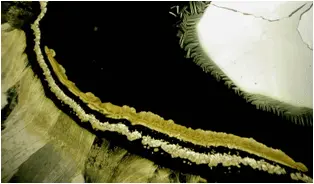
This example shows why visual thermal evidence can be useful when DSC or TGA events overlap or need explanation. Hot-stage optical microscopy can reveal melting, crystallization, and cocrystal formation under a programmed temperature condition. The example below shows formation of a cocrystal at the eutectic region.
Hot-stage microscopy and Kofler cocrystal formation example. The yellow band in the image marks cocrystal formation at the eutectic region between two melted compounds. The example is useful because hot-stage microscopy provides direct visual evidence of melting, crystallization, desolvation, and phase transitions that may be hidden or overlapping in DSC. It should be paired with XRPD, Raman/IR, or another form-confirming method before assigning a specific solid form. Source: Triclinic Labs thermal-analysis material.
Technical Resources and Publications
These examples include technical resources, regulatory guidances, or literature relevant to the technique. Download buttons are placed at the bottom-left of each example.
Amorphous Content Quantitation via mDSC
Author: Triclinic Labs
Publication date: 2025
Abstract: This application note uses modulated DSC to quantify amorphous content in crystalline API by evaluating heat-capacity change at the glass transition, illustrating how thermal methods can support low-level amorphous-content control and stability interpretation.
A Comprehensive Approach for Solid Form Selection in Preclinical Development and Beyond
Author: Melanie Bevill, Chris Seadeek, Nico Setiawan, Shawn Comella, Blaise Mibeck, and Steef Boerrigter
Publication date: November 2023
Abstract: Solid-form screening and selection connect crystallinity, stability, solubility, hygroscopicity, manufacturability, regulatory needs, and IP objectives. Analytical techniques should therefore be selected according to the development decision rather than a fixed instrument list.
ICH Q2(R2) Validation of Analytical Procedures and ICH Q14 Analytical Procedure Development
Author: International Council for Harmonisation / FDA
Publication date: 2024
Abstract: FDA notes that ICH Q2(R2) and Q14 describe validation and development principles for analytical procedures used to assess drug substance and drug product quality. These guidances frame FDA expectations for specificity, accuracy, precision, range, robustness, lifecycle management, and fit-for-purpose method evidence.
Provides rapid molecular-identification, functional-group, solid-form, mixture, and spatial-distribution evidence using Raman, FTIR, IR imaging, and UV/Vis.
Tell Triclinic what sample you have, what decision the data must support, what prior data are available, and whether cGMP, release, validation, or regulatory documentation is required.