Unknown chromatographic peak
An unexpected high-performance liquid chromatography (HPLC) or ultra-high-performance liquid chromatography (UPLC) peak appears during development, release testing, or stability.


An unknown peak appearing during development, release testing, or stability can delay decisions until the team understands what it is, where it came from, and whether it matters. Triclinic Labs scopes pharmaceutical impurity and degradant investigations around that decision—not around an organizational category or a single instrument.
Liquid chromatography-high-resolution mass spectrometry (LC-HRMS) and tandem mass spectrometry (MS/MS) often provide the first structural evidence for soluble organic unknowns. When the sample is a particle, solid, mixture, or ambiguous mass-spectrometric signal, Triclinic can add orthogonal spectroscopy, microscopy, diffraction, nuclear magnetic resonance (NMR), reference comparison, or synthesis as the evidence requires.
An unexpected high-performance liquid chromatography (HPLC) or ultra-high-performance liquid chromatography (UPLC) peak appears during development, release testing, or stability.
Heat, light, oxidation, hydrolysis, pH, moisture, or formulation conditions generate a new component that must be identified and connected to a degradation pathway.
Starting materials, intermediates, side reactions, catalysts, reagents, or synthesis byproducts create an unknown that may require structural assignment and source evaluation.
Active pharmaceutical ingredient (API)-excipient interactions, packaging effects, formulation chemistry, or manufacturing conditions produce an unexpected component.
An extraneous chemical or material is introduced through handling, manufacturing, packaging, process-contact materials, or the environment.
When LC-MS is not the right starting point, Raman spectroscopy, Fourier-transform infrared (FTIR) spectroscopy, scanning electron microscopy with energy-dispersive X-ray spectroscopy (SEM/EDX), X-ray powder diffraction (XRPD), Microcrystal Electron Diffraction (MicroED), or microscopy may identify the material and its location.
The workflow follows the unknown from detection to the level of structural certainty required. It does not assume that an accurate mass alone proves a structure.
Mass-spectrometric and crystallographic evidence answer different parts of the structure question. High-resolution mass spectrometry constrains the accurate mass, elemental formula, and fragment possibilities. MicroED can determine the crystal structure from a nanoscale crystallite. Used together, they can narrow molecular possibilities when chromatography provides too little isolated material for a conventional structure-elucidation workflow.
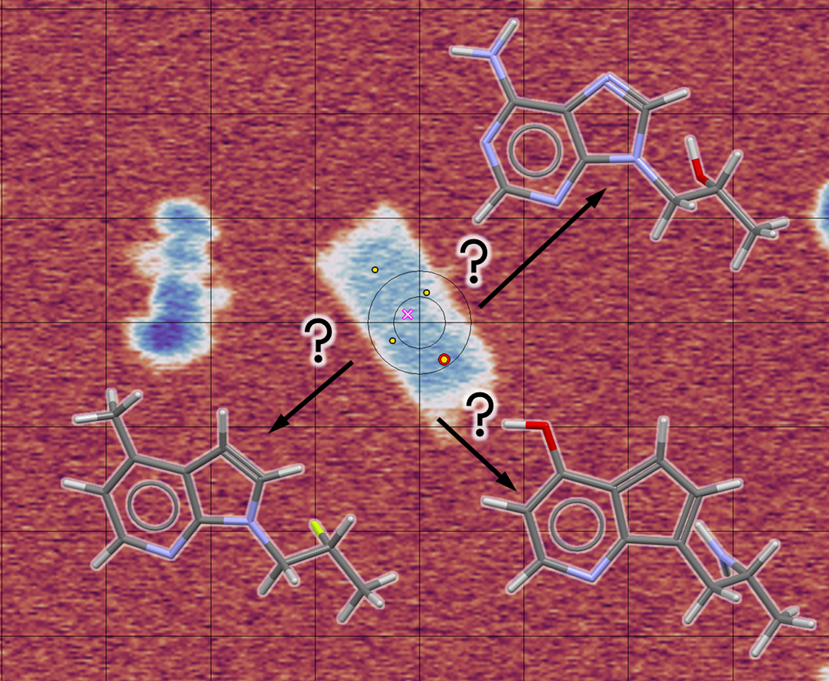
The report distinguishes what the data support from what remains unproven.
Accurate mass, candidate formulae, fragments, or contextual chemistry support a plausible assignment, but material alternatives remain and confirmatory evidence is limited.
Multiple lines of evidence converge, such as MS/MS, retention behavior, process or degradation chemistry, literature, and an orthogonal result, but definitive reference or structural proof is not available.
The assignment is supported by fit-for-purpose confirmatory evidence, such as an authentic standard comparison, isolation with NMR, synthesis, or crystallographic structure determination.
| Evidence needed | Possible starting techniques | What the evidence can resolve |
|---|---|---|
| Mass, formula, and fragments for a soluble organic peak | LC-HRMS and MS/MS | Candidate formulae, isotope patterns, substructures, fragmentation pathways, and comparisons with known chemistry. |
| Connectivity or definitive molecular structure | Isolation with NMR; synthesis or authentic reference comparison | Connectivity, structural alternatives, and confirmation when mass-spectrometric evidence remains ambiguous. |
| Volatile or semi-volatile component | Gas chromatography-mass spectrometry (GC-MS) | Separation and identification of residual solvents, volatile degradants, contaminants, or process-related compounds. |
| Particle, residue, film, or heterogeneous solid | Microscopy, Raman, FTIR, SEM/EDX, XRPD, or MicroED | Molecular class, elemental composition, phase identity, morphology, spatial location, or crystal structure. |
| Formation pathway or source | Forced degradation, time-course comparison, formulation controls, process samples, and reference materials | Whether the unknown is consistent with degradation, an API-excipient reaction, process chemistry, packaging, or contamination. |
This white paper shows how accurate-mass evidence and MicroED can be combined when a crystalline impurity particle requires both formula constraints and structure determination.
Download this WhitepaperObtain accurate-mass, isotope-pattern, and fragment evidence for unknowns, impurities, and degradants.
Isolate or enrich an unknown peak when mixture complexity, coelution, or confirmatory NMR requires purified material.
Resolve connectivity and structural alternatives when enough isolated material is available.
Identify particles, residues, fibers, films, deposits, and other extraneous materials using orthogonal evidence.
Connect an identified material to process, packaging, raw-material, or environmental sources.
The investigation starts with the chromatographic behavior, accurate mass, isotope pattern, and tandem mass spectra. Those data are compared with the API, process chemistry, degradation pathways, formulation components, and available references. Isolation, NMR, synthesis, or an authentic standard may be needed to confirm the structure.
High-resolution mass spectrometry can provide accurate mass, isotope-pattern information, candidate elemental formulae, and fragment evidence. It narrows the structural possibilities but does not, by itself, prove a unique structure.
Liquid chromatography-tandem mass spectrometry (LC-MS/MS) is often the best starting point for a low-level soluble impurity because it couples separation with mass and fragmentation data. NMR is more definitive for connectivity and stereochemical questions but usually requires an isolated, sufficiently pure, and adequately concentrated sample.
The amount depends on concentration, ionization response, matrix complexity, separation quality, and the evidence required. Mass-spectrometric work can begin with trace levels that produce adequate signal, while isolation and NMR usually require more material. Triclinic reviews the available sample and data before defining the workflow.
Isolation is usually needed when coelution or mixture complexity prevents interpretation, when NMR or another confirmatory method is required, or when a reference material must be prepared. Strong liquid chromatography-mass spectrometry evidence may support a tentative or probable assignment without isolation.
Controlled exposure to heat, light, oxidation, hydrolysis, pH, or moisture can reproduce products and reveal how they form. Comparing stressed and unstressed samples, time points, and formulation components helps distinguish true degradants from process impurities or unrelated contaminants.
A measured accurate mass may fit multiple isomers or structures with the same elemental formula. Fragmentation, retention behavior, known chemistry, orthogonal spectroscopy, reference comparison, NMR, synthesis, or crystallography may be required to distinguish those alternatives.
The investigation compares the API, individual excipients, formulated product, controls, and stressed or aged samples. Accurate mass, tandem mass spectra, isotope patterns, reaction chemistry, and confirmatory evidence are used to determine whether the unknown is consistent with an API-excipient reaction product.
The study reviews when the peak appeared, how it changes across conditions and time points, and whether it tracks with heat, light, humidity, oxygen, pH, packaging, or formulation composition. Analytical work then tests the most plausible degradation or interaction pathways and defines the level of identification supported by the evidence.

Share the chromatogram, mass-spectrometric data, sample matrix, concentration, stability or process history, available reference materials, and the decision the identification must support.