Build crystallization processes that reproducibly control the selected form, purity, particle attributes, and scale-up behavior.
Develop crystallization methods that produce material with the intended form, purity, and particle attributes
Almost all active pharmaceutical ingredients (APIs) are crystallized at some stage, and many are formulated as crystalline materials. A crystalline API must exhibit consistent physical properties from gram-scale development through multi-kilogram supply. Crystallization method development turns form selection into a reproducible manufacturing process.
The content of this page has been scientifically reviewed by Aeri Park, Ph.D., COO at Triclinic Labs · Updated 8/1/2026
Content also reviewed by Chris Seadeek, Sr. Director at Triclinic Labs · Updated 8/1/2026
Solid-form control during crystallization
The selected solid form is chosen for properties such as dissolution rate, bioavailability, stability, handling, or intellectual property. The crystallization process must selectively produce that form with high efficiency, chemical purity, and polymorphic purity.
Instead of repeated attempts using random process conditions, Triclinic identifies the nucleation and growth events and develops a process to control them. That approach improves lot-to-lot consistency and scale-up predictability.
Process variables should be tested because they create the conditions under which nucleation and growth occur. A method that works once at small scale is not robust until the sensitive variables and likely failure modes are understood.
Crystallization attributes that affect downstream development
Control target
Why it matters
Typical Triclinic work
Desired solid form and polymorphic purity
The process must selectively produce the intended form; the wrong polymorph, hydrate, solvate, or non-crystalline material can change performance or the control strategy.
Evaluate the process-relevant solid-form landscape and the effects of seeding, solvent, temperature, water activity, slurry conditions, and other process variables.
Chemical purity
The process must meet target specifications for process impurities and residual solvents.
Systematic crystallization optimization and analytical confirmation.
Particle size, morphology, and distribution
Size and habit influence bioavailability, filtration, drying, flow, compressibility, and drug-product quality.
Control nucleation and growth rates, evaluate particle attributes, and adjust process conditions.
Chiral resolution
Crystallization can be an economical route to enantiomerically pure material.
Evaluate diastereomeric salt formation, racemate or conglomerate behavior, and crystallographic evidence where chiral resolution is relevant.
Scale-up and transfer
Heat- and mass-transfer kinetics and mixing dynamics change with scale and equipment configuration and can alter solid form or particle attributes.
Scale-up risk assessment, manufacturer support, and process-transfer troubleshooting.
The final crystallization recommendation should identify controllable process parameters, not just successful laboratory conditions. That means documenting which variables affect form, purity, morphology, isolation, drying, and scale-up risk.
How Triclinic scopes crystallization method development
Crystallization method development is where form selection becomes a reproducible process. The work should connect solvent, supersaturation, seeding, temperature, water activity, agitation, isolation, drying, and process history to the intended form and material attributes.
Triclinic scopes crystallization studies around the control target: produce the chosen polymorph, avoid hydrate or solvate conversion, improve chemical purity, manage particle habit and size distribution, or provide process evidence for technology transfer.
Define the selected form and acceptable attributes. Identify the targeted polymorph, relevant hydrates or solvates, chemical purity, residual-solvent target, morphology, particle size, and downstream handling needs.
Map the process variables. Test solvent systems, concentration, temperature, antisolvent addition, cooling profile, seeding, aging, water activity, agitation, and isolation or drying conditions.
Confirm form and material behavior. Use X-ray powder diffraction (XRPD), Raman or infrared (IR) spectroscopy, differential scanning calorimetry (DSC), thermogravimetric analysis (TGA), microscopy, particle-size analysis, chromatography, and post-stress characterization to determine whether the method is robust.
Deliver a transfer-ready recommendation. Summarize reproducible laboratory conditions, process sensitivities, failure modes, and next experiments needed for scale-up or manufacturer implementation.
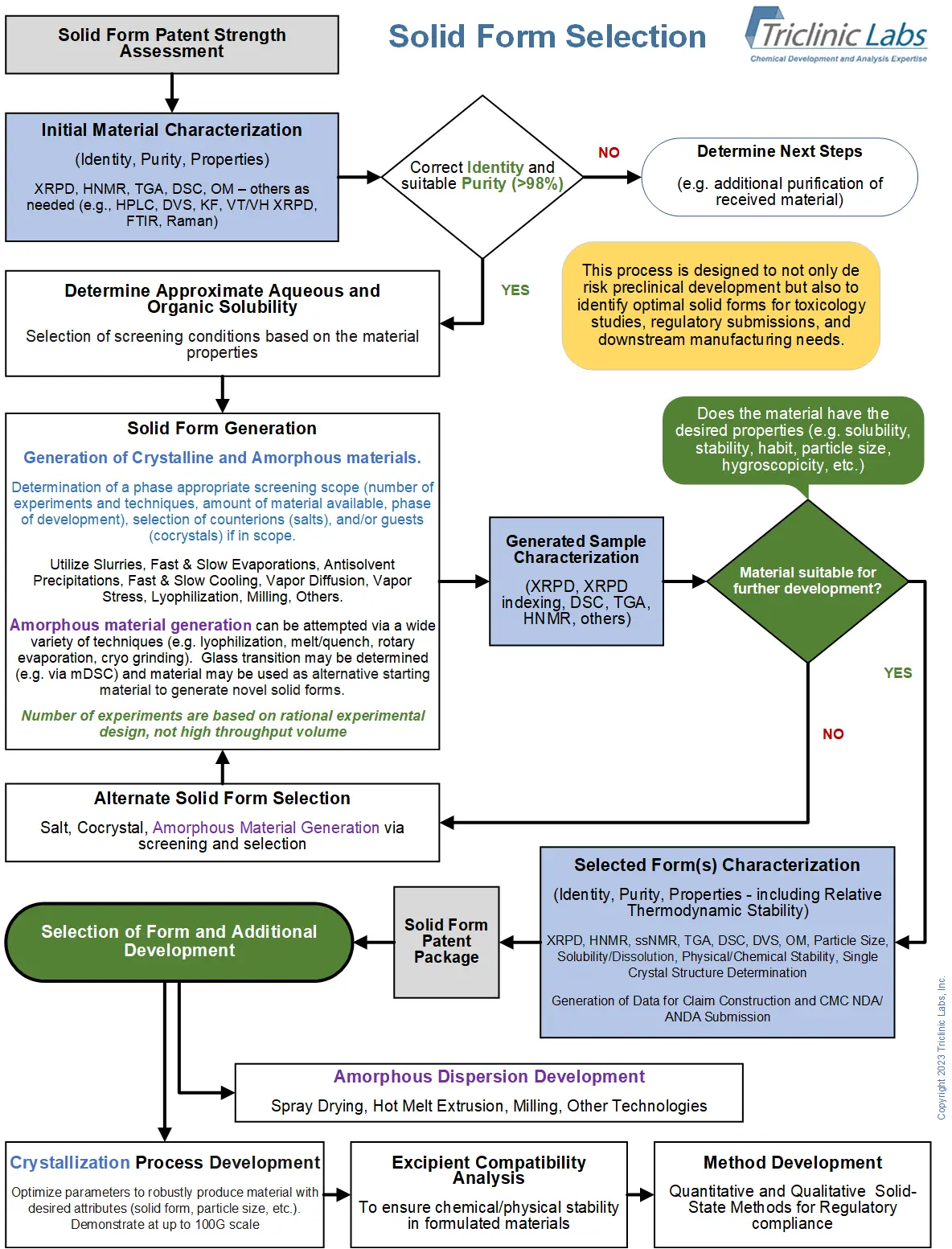
Solid form development decision tree
Use this decision tree to connect form selection, form control, formulation, process development, method development, release testing, stability, and lifecycle risk before the examples and publications section.
Crystallization method development should control both pathway and endpoint
A crystallization method is not robust until it controls how the desired form is reached and how unwanted forms are avoided. Kinetic products, metastable intermediates, hydrates, solvates, particle habit, and residual amorphous material can all be created during the process.
Development should connect nucleation pathway, aging, water activity, temperature, solvent history, seeding, mixing, isolation, drying, and post-processing to the selected form and required material attributes.
Decision signal
What to test
Actionable output
Kinetic pathway
Fast nucleation, surface evaporation, antisolvent addition, or temperature shocks can create forms not seen under equilibrium conditions.
Screen process-relevant pathways and evaluate whether seeding improves control of the intended form.
Thermodynamic endpoint
Slurry aging, competitive slurries, and temperature-dependent solubility reveal which form is most stable at different process stages.
Use stable-form relationships to guide process control.
Particle attributes
Habit, size, hydration, and agglomeration affect filtration, drying, flow, and formulation.
Tie particle observations to solid-form and process history.
Examples and Publications.
Examples, publications, and source-backed materials
What Most Contract Research Groups Won't Tell You About Solid Form Screening
Authors: Shawn C. Comella and Aeri Park, Ph.D.
Publication date: Q3 2026
Descriptive abstract: This application note explains why experiment count is a weak measure of solid-form screening quality. It presents a risk-based, stage-appropriate framework for polymorphs, hydrates, solvates, salts, cocrystals, and amorphous forms, and connects screening design, thermodynamic ranking, orthogonal characterization, and control strategy to the development decision.
A Comprehensive Approach for Solid Form Selection in Preclinical Development and Beyond
Author: Melanie Bevill, Chris Seadeek, Nico Setiawan, Shawn Comella, Blaise Mibeck, and Steef Boerrigter
Publication date: November 2023
Descriptive abstract: This application note frames solid-form selection as a decision-driven process that compares polymorphs, salts, cocrystals, amorphous materials, hydrates, solvates, and other non-crystalline forms against developability criteria. It emphasizes crystallinity, stability, solubility, hygroscopicity, manufacturability, regulatory needs, financial risk, and intellectual property strategy rather than a high-throughput experiment count.
Diversity in Single- and Multiple-Component Crystals. The Search for and Prevalence of Polymorphs and Cocrystals
Author: G. Patrick Stahly
Publication date: May 18, 2007
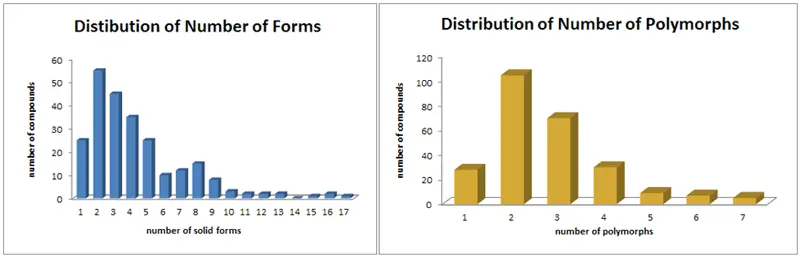
Descriptive abstract: This Crystal Growth & Design review describes polymorph-screening procedures, cocrystal screening, and the observed prevalence of multiple solid forms in screening experience. It supports the central development point that alternate solid forms are common enough to require deliberate screening, characterization, and control rather than assuming the first crystalline lot is representative.
In situ observation of Theophylline anhydrous forms II, III, V, and I* using Variable-Temperature, Variable-Relative Humidity X-ray powder diffraction
Author: Stephan X. M. Boerrigter and Blaise A. F. Mibeck
Publication date: September 2023
Descriptive abstract: This application note uses variable-temperature, variable-relative-humidity XRPD to observe theophylline phase behavior across temperature and humidity conditions. It demonstrates how in situ diffraction can reveal polymorphic transitions, dehydrated-hydrate behavior, and temperature/RH-dependent phase relationships that matter for screening, storage, and process control.
ANDAs: Pharmaceutical Solid Polymorphism: Chemistry, Manufacturing, and Controls Information
Author: U.S. Food and Drug Administration, Center for Drug Evaluation and Research
Publication date: July 2007
Descriptive abstract: This FDA guidance addresses CMC information for ANDA submissions when a drug substance can exist in polymorphic forms. It is useful context for development pages because form sameness, monitoring, control, and drug-product relevance are regulatory issues, not just analytical preferences.
Crystallization method development is most effective when connected to the solid-form landscape. It should not be isolated from polymorph, hydrate, solvate, salt, cocrystal, amorphous, or formulation risks.
The same physical attributes that determine API processability - form, morphology, particle size, water content, and stress sensitivity - also affect drug-product manufacturability and stability.
Determine whether an API can exist in multiple crystalline forms and whether form differences change solubility, dissolution, stability, manufacturing, drug-product performance, or IP.
Screen ionizable APIs for counterions that improve crystallinity, solubility, dissolution, stability, manufacturability, or developability while controlling disproportionation risk.
Resolve form conversion, failed crystallizations, process sensitivity, stability drift, unexplained PK/dissolution changes, and batch-to-batch material differences.
Continue the solid-form program without returning to the service hub
Use the evidence from this service to select the next development decision. Triclinic can connect form selection, analytical characterization, crystallization and scale-up, and phase-appropriate cGMP support in one program.
Form selection
Compare polymorph, salt, cocrystal, and amorphous options against stability, solubility, manufacturability, and development-stage risk.
It reproducibly produces the intended form with acceptable chemical purity, polymorphic purity, particle attributes, yield, and downstream performance across relevant scale and process variation.
Can crystallization improve chemical purity?▾
Yes. Crystallization is often an effective industrial purification method and can reduce process impurities or residual solvents when optimized correctly.
Can Triclinic support API manufacturers?▾
Yes. Triclinic can develop background information for form control, support scale-up, evaluate vendor processes, and troubleshoot OOS or transfer issues.
Which process variables most strongly affect crystallization outcome?▾
Solvent composition, supersaturation, nucleation history, seeding, temperature profile, antisolvent addition, water activity, agitation, aging, isolation, washing, and drying can all affect solid form, purity, habit, and particle attributes.
Talk to a Triclinic Labs scientist about Crystallization Method Development
Send the material history, current data package, process conditions, development objective, and timeline. Triclinic will route the request to the right solid-form scientist. For a connected program from candidate nomination through IND, explore the candidate-to-IND solid-form development pathway.