Manufacturing Troubleshooting for Pharmaceutical Solid Forms
Use solid-state chemistry, analytical interpretation, and process history to identify root causes and recover control.
Use solid-state science to diagnose performance, process, and stability failures
Changing drug-product performance, loss of crystallization control, inconsistent active pharmaceutical ingredient (API) properties, failure on stability, unexpected water uptake, form conversion, or batch-to-batch differences should trigger a structured solid-state investigation. Project planning and interpretation are often more important than generating more unconnected data.
The content of this page has been scientifically reviewed by Aeri Park, Ph.D., COO at Triclinic Labs · Updated 8/1/2026
Content also reviewed by Chris Seadeek, Sr. Director at Triclinic Labs · Updated 8/1/2026
Problems Triclinic can help with
Each molecule has a unique physical-property profile. A single screening protocol or standard analytical package does not fit every solid-form problem. Triclinic helps interpret existing data, design targeted experiments, and identify the shortest path to the root cause.
Problem areas include non-optimal drug-substance properties, late-stage form changes, salt selection, cocrystal development, amorphous stability, analytical method development, ultra-low-loading release testing, contaminant identification, counterfeit analysis, prior-art reproduction, and chiral resolution.
Solubility, stability, crystallization failure, hygroscopicity, manufacturability, filterability, and compressibility issues
Polymorphic determination and control, including late-stage form changes
Analytical method development, validation, and release testing at very low loading
Failure on storage or stability, drug-product appearance changes, or batch-dependent performance
Interpretation of prior experiments and design of focused follow-up studies
A useful troubleshooting plan distinguishes between material change and method limitation. A new result may reflect a real form conversion or contamination event, but it may also reflect preferred orientation, low-level detection limits, excipient interference, sample handling, or a non-specific method.
Escalation triggers and immediate actions
Signal
Solid-state hypothesis to test
Immediate action
Lot-to-lot PK scatter
Different polymorph ratio, crystallinity, hydrate state, particle habit, or amorphous content.
Run form ID on retained lots; compare dissolution and residual solids.
Dissolution drift on stability
Phase conversion, hydrate formation, salt disproportionation, or crystallization from ASD.
Analyze stressed samples by a phase-specific method and link to performance.
Process-induced phase transformations
Milling, compression, wet granulation, or solvent exposure creates or destroys a form.
Check pre- and post-process form and stress process-relevant conditions.
Unexpected water uptake
Hygroscopicity, hydrate formation, amorphous plasticization, or excipient-mediated water activity.
Use DVS plus post-stress XRPD/Raman/IR analysis.
Method choice must match the failure mode
Question
Useful methods
Watch-out
What crystalline phase is present?
XRPD; Raman/IR; ssNMR for difficult mixtures or drug-product matrices.
XRPD can be limited by low API loading, preferred orientation, excipient overlap, or low-level phase impurity.
Is water or solvent involved?
Thermogravimetric analysis (TGA), TGA with infrared evolved-gas analysis (TG-IR), Karl Fischer titration, dynamic vapor sorption (DVS), and X-ray powder diffraction (XRPD), Raman, or infrared (IR) spectroscopy after humidity or solvent stress.
Mass change alone is not structural proof; pair it with phase analysis.
What are the thermal relationships?
DSC, hot-stage microscopy, variable-temperature XRPD when needed.
Heating can create artifacts or obscure overlapping events.
Does form affect performance?
Solubility and dissolution across relevant pH ranges and biorelevant media, slurry conversion, and residual-solids analysis.
Performance data without phase identification can misassign the cause.
Can the form be controlled in the drug product?
XRPD, Raman, IR, solid-state nuclear magnetic resonance (ssNMR), or a justified surrogate performance method.
Specificity must be demonstrated in the API and, when needed, in the excipient matrix.
For drug products, method specificity should be treated as part of the root-cause question. A method that identifies neat API may not identify the same low-level phase in an excipient matrix without validation or orthogonal confirmation.
How Triclinic scopes a solid-form troubleshooting investigation
A troubleshooting project should not start with a broad analytical shopping list. It should start with the symptom, the decision deadline, the batch history, and the shortest credible set of hypotheses that can explain the failure.
Triclinic looks for evidence that connects the observed failure to a material change, analytical method limitation, contamination or mix-up, process variable, humidity or solvent exposure, particle attribute, or solid-form conversion. The goal is not more data; it is a defensible root-cause path and a control recommendation.
Frame the failure mode. Define the observed change: OOS result, dissolution drift, stability failure, new XRPD peak, DSC change, lot-to-lot PK scatter, water uptake, visual change, or process inconsistency.
Reconstruct material history. Compare retained lots, supplier batches, processing steps, humidity and solvent exposure, milling, granulation, drying, packaging, and analytical methods.
Test competing hypotheses. Use targeted XRPD, Raman/IR, DSC/TGA, DVS, Karl Fischer, chromatography, microscopy, LC/MS, GC/MS, chemometrics, or stress studies only where they answer the failure hypothesis.
Report the control path. Separate proven cause, likely cause, ruled-out causes, analytical limitations, and recommended next controls or confirmatory experiments.
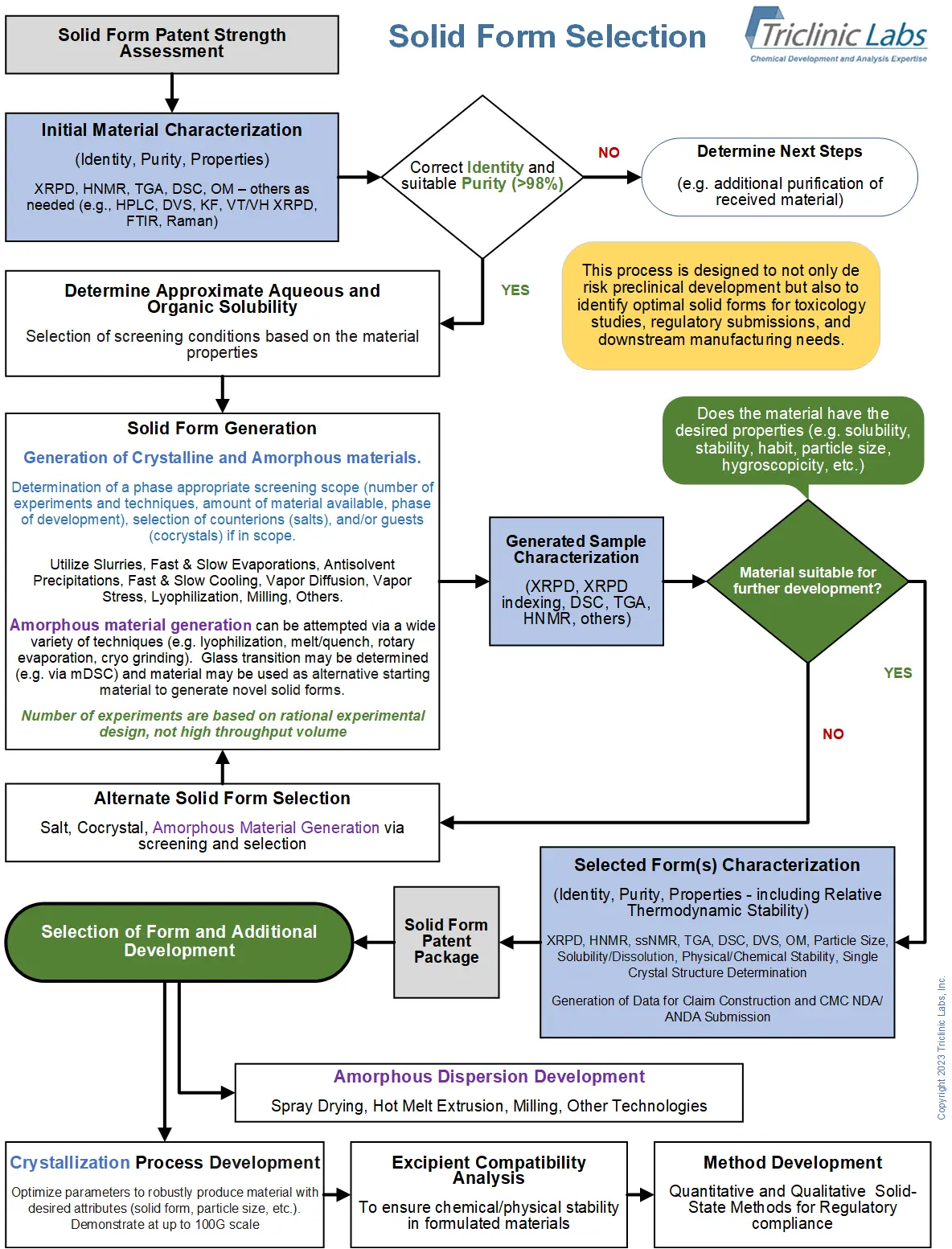
Solid form development decision tree
Use this decision tree to connect form selection, form control, formulation, process development, method development, release testing, stability, and lifecycle risk before the examples and publications section.
Do not call it formulation noise until solid form is checked
PK scatter, dissolution drift, stability failure, process sensitivity, or lot-to-lot differences should be tested against polymorph, hydrate, solvate, salt, cocrystal, particle habit, and amorphous-content hypotheses before they are written off as ordinary formulation variability.
The material state can change across crude API, recrystallized API, wet cake, dried cake, micronized powder, wet-granulated intermediates, dried granules, tablets, dissolution residues, and stability samples. Troubleshooting should map those material states rather than inspect only one retained powder.
Decision signal
What to test
Actionable output
PK or dissolution variability
Retained lots may differ in form, hydration, solvation, crystallinity, habit, or amorphous content.
Compare retained lots and residual solids after performance testing.
Process-induced phase transformations
Milling, drying, compression, wet granulation, or solvent exposure can create or destroy forms.
Check pre- and post-process samples using phase-specific methods.
Stability failure
Humidity, temperature, excipients, or microenvironment pH can trigger conversion.
Use stress studies with form ID before and after exposure.
Examples and Publications.
Examples, publications, and source-backed materials
What Most Contract Research Groups Won't Tell You About Solid Form Screening
Authors: Shawn C. Comella and Aeri Park, Ph.D.
Publication date: Q3 2026
Descriptive abstract: This application note explains why experiment count is a weak measure of solid-form screening quality. It presents a risk-based, stage-appropriate framework for polymorphs, hydrates, solvates, salts, cocrystals, and amorphous forms, and connects screening design, thermodynamic ranking, orthogonal characterization, and control strategy to the development decision.
A Comprehensive Approach for Solid Form Selection in Preclinical Development and Beyond
Author: Melanie Bevill, Chris Seadeek, Nico Setiawan, Shawn Comella, Blaise Mibeck, and Steef Boerrigter
Publication date: November 2023
Descriptive abstract: This application note frames solid-form selection as a decision-driven process that compares polymorphs, salts, cocrystals, amorphous materials, hydrates, solvates, and other non-crystalline forms against developability criteria. It emphasizes crystallinity, stability, solubility, hygroscopicity, manufacturability, regulatory needs, financial risk, and intellectual property strategy rather than a high-throughput experiment count.
Chemical Identity Testing by Remote-Based Dispersive Raman Spectroscopy
Author: David E. Bugay and Robert C. Brush
Publication date: 2010
Descriptive abstract: This paper describes qualitative chemical-identification methods using hand-held Raman spectrometers, including method development, transfer, and validation concepts. For troubleshooting, the key point is that spectroscopy can support rapid identity testing and counterfeit or mix-up investigations, but the decision algorithm and method specificity must be fit for the sample and setting.
Chemometrics for Semi-Quant and Pure Curve Resolution
Author: Simon Bates, Ph.D.
Publication date: 2011
Descriptive abstract: This white paper discusses chemometric methods for pattern matching, clustering, semi-quantitative analysis, and pure-curve resolution. It is relevant to manufacturing troubleshooting because real pharmaceutical materials may not behave like ideal calibration mixtures, so data interpretation must account for process history, mixture behavior, and non-linear response.
Quantitation of Amorphous Content in Crystalline API via the Relative Heat Capacity at the Glass Transition Temperature
Author: Nico Setiawan, Ph.D., and Liping Meng, Ph.D.
Publication date: December 2025
Descriptive abstract: This application note addresses unintentional amorphization of crystalline API during drying, milling, and wet or dry granulation. It describes using modulated DSC and the relative heat capacity at the glass transition temperature to quantify amorphous content where melt-based crystallinity quantitation was not suitable because the compound decomposed at melting.
Application of Low-Frequency (LF) Raman Spectroscopy to an Isoenergetic Polymorph Study
Author: G. Patrick Stahly, Ph.D.
Publication date: April 2019
Descriptive abstract: This white paper explains why low-frequency Raman can differentiate structurally similar polymorphs through lattice vibrations. The example is relevant to polymorph screening and troubleshooting because it shows that DSC, TGA, IR, and standard Raman may fail to separate forms that LF Raman and competitive slurry experiments can distinguish.
Do not diagnose pharmacokinetic (PK) scatter, dissolution drift, or stability failure as formulation noise until the solid form has been checked. A short early-stage rationale should document material history, methods used, forms observed, open risks, and the next decision gate. When the investigation identifies a newly observed crystalline phase, use the late-polymorph risk guide to confirm the form, assess its development relevance, and define the required control response.
By candidate nomination and cGMP supply, that rationale should mature into a control strategy linking form, process, specifications, stability, packaging, site transfer, and lifecycle/IP decisions.
Other services available
Polymorph Screening and Selection
Determine whether an API can exist in multiple crystalline forms and whether form differences change solubility, dissolution, stability, manufacturing, drug-product performance, or IP.
Screen ionizable APIs for counterions that improve crystallinity, solubility, dissolution, stability, manufacturability, or developability while controlling disproportionation risk.
Continue the solid-form program without returning to the service hub
Use the evidence from this service to select the next development decision. Triclinic can connect form selection, analytical characterization, crystallization and scale-up, and phase-appropriate cGMP support in one program.
Form selection
Compare polymorph, salt, cocrystal, and amorphous options against stability, solubility, manufacturability, and development-stage risk.
What should be sent for a troubleshooting consultation?▾
Material history, batch records, process conditions, analytical data, chromatograms, XRPD/Raman/IR/DSC/TGA/DVS results, formulation composition, stability observations, and the exact failure mode.
Can Triclinic work from existing data?▾
Yes. Existing data often contain the clue. Triclinic can interpret it, identify gaps, and propose focused experiments rather than starting with a broad data-generation package.
What if the root cause is not solid form?▾
Triclinic can triage contaminant, counterfeit, impurity, method, crystallization, particle attribute, and materials-characterization explanations and route the project appropriately.
How should a conforming and nonconforming lot comparison be designed?▾
The comparison should control sample history and use the smallest orthogonal method set capable of distinguishing form, chemistry, moisture or solvent, morphology, particle attributes, contamination, and analytical artifacts.
Talk to a Triclinic Labs scientist about Manufacturing Troubleshooting for Pharmaceutical Solid Forms
Send the material history, current data package, process conditions, development objective, and timeline. Triclinic will route the request to the right solid-form scientist.