What is this?
cGMP Raman and FTIR are vibrational spectroscopy methods used for chemical fingerprinting, raw-material identification, form differentiation, contaminant identification, and controlled mixture-analysis applications.


Spectroscopic identification is valuable only when the data and interpretation are reliable enough to support the regulated decision. Triclinic Labs applies Raman spectroscopy and Fourier-transform infrared (FTIR) spectroscopy using qualified instrumentation, validated or verified methods, and complete cGMP documentation to identify raw materials, distinguish solid forms, investigate contaminants and counterfeit materials, characterize formulation components, and support method development. Raman and FTIR can also support selected degradation investigations when vibrational spectroscopy is appropriate, although mass spectrometry is generally preferred for identifying degradation products.
Our scientists interpret spectral differences within the material and sample context, using complementary techniques when a library match or single spectrum does not provide sufficient evidence.
Content scientifically reviewed by Andy Gilkison, Ph.D., Senior Director, Method Development at Triclinic Labs · Updated 9/1/2026


cGMP Raman and FTIR are vibrational spectroscopy methods used for chemical fingerprinting, raw-material identification, form differentiation, contaminant identification, and controlled mixture-analysis applications.
Use Raman or FTIR when the quality question can be answered by molecular vibrations, polymorph discrimination, material comparison, contaminant identification, or a validated raw-material identification method.
Spectra can be affected by fluorescence, water, particle size, orientation, matrix overlap, laser damage, pressure/contact artifacts, baseline correction, and spectral pre-processing choices.
Amounts may be very small for identification, but method validation, calibration, detection-limit, and mixture studies require representative standards and matrix controls.
Complementary techniques include X-ray powder diffraction (XRPD), nuclear magnetic resonance (NMR), chromatography, mass spectrometry, microscopy, scanning electron microscopy with energy-dispersive X-ray spectroscopy (SEM/EDX), thermal analysis, and particle methods. They add phase, connectivity, quantitative, elemental, spatial, and thermal evidence to Raman and FTIR identification.
FDA cares that the method is scientifically justified, specific for the intended attribute in the real matrix, controlled under the quality system, validated or verified where appropriate, data-integrity compliant, and lifecycle managed.
Common mistakes include using exploratory data as release evidence, validating the wrong matrix, ignoring sample preparation, under-documenting controls, relying on one technique when orthogonal evidence is needed, or failing to define the decision before testing.
Triclinic uses cGMP Raman and FTIR for regulated identity, material-comparison, contaminant, polymorph, and functional-group questions where spectral evidence must be collected and reviewed under controlled procedures. Real-world applications include raw-material identity support, release and stability testing, foreign-particle or residue investigations, and validated or verified methods that provide rapid orthogonal evidence for quality decisions.
Exploratory data can help choose a method, but release or filing-support data require controlled execution. The method must be suitable for the matrix, the quality attribute must be defined, reference standards and controls must be appropriate, and the report or CoA must say only what the data support.
| cGMP concern | Why it matters | Practical control |
|---|---|---|
| Method status | Exploratory, verified compendial, validated custom, and transferred methods have different evidence requirements. | Define status before testing and document any development, verification, validation, or transfer work. |
| Sample matrix | Specificity can fail in real drug product, excipient, talc, low-dose, or complex solid mixtures. | Use representative material, placebo/matrix controls, spike studies, or orthogonal methods where needed. |
| Data integrity | Release or stability results must survive QA review, audit, and regulatory scrutiny. | Use controlled records, system suitability, analyst review, deviations/OOS process, and traceable calculations. |
The table distinguishes qualified cGMP Raman and FTIR platforms from related non-cGMP Raman and infrared-imaging capabilities.
| Instrument or platform | Brand, model, software, or detector | Additional capabilities and use |
|---|---|---|
| Dispersive Raman microscopy (non-cGMP) | Renishaw InVia Qontor Raman microscope with DMLM Leica microscope, 532 and 785 nm lasers, and CCD detector | Chemical imaging, confocal microsampling, polymorph discrimination, carbon-nanotube characterization, and spatial component mapping. |
| FT-Raman | Thermo Nicolet iS50 spectrometer; 1064 nm excitation laser; InGaAs detector; OMNIC v9.11 software with spectral libraries | Micro and macro Raman sampling, reduced fluorescence for selected samples, library matching, and non-destructive molecular fingerprinting. |
| Low-frequency Raman (non-cGMP) | Ondax THz-Raman system with probe | Stokes and anti-Stokes signals from +/-5 cm-1 to 200 cm-1, or 150 GHz to 6 THz, for lattice-mode/polymorph-sensitive measurements. |
| Infrared imaging (non-cGMP) | Thermo iN10 MX with software v1.7.198 | IR chemical imaging, ATR/reflection/transmission sampling, microsampling, real-time particle identification, and distribution mapping. |
| FT-IR | Thermo Nicolet iS50; ATR, diffuse reflectance, transmission, and gas-cell sampling; OMNIC v9.11 software with spectral libraries | Functional-group identification, spectral-library matching, gas-cell/TGA-IR evolved-gas analysis, and organic/inorganic material identification. |
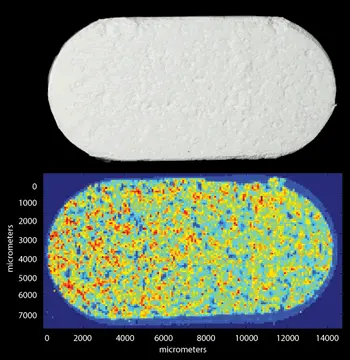
This example shows how vibrational spectroscopy can move from qualitative identification to spatially resolved product understanding. Raman and FTIR methods can support molecular fingerprinting, polymorph differentiation, raw-material identity, and contaminant identification, while chemical imaging is performed as non-cGMP work. For cGMP Raman or FTIR use, the spectral method must be specific for the matrix and validated, verified, or transferred for the decision it supports.
These examples cite Triclinic source documents, regulatory guidances, or literature relevant to this cGMP service. Download buttons are positioned at the bottom-left of each example.
Author: Triclinic Labs
Publication date: 2019
Abstract: This white paper describes how low-frequency Raman can distinguish polymorphic forms through lattice-mode information, making Raman an important orthogonal method for form ID and cGMP solid-mixture method development.
Author: Triclinic Labs
Publication date: April 2023
Abstract: This application note combines dissolution, XRPD, and low-frequency Raman mapping to connect chemical identity, phase, and spatial distribution in formulation-relevant samples.
Author: International Council for Harmonisation / FDA
Publication date: 2024
Abstract: These harmonized guidances describe validation and development principles for analytical procedures used to assess drug-substance and drug-product quality. They anchor expectations for specificity, accuracy, precision, range, robustness, lifecycle management, and fit-for-purpose method evidence in cGMP work.
Use cGMP NMR for identity, purity, qNMR, reference-material verification, method development, validation, and release testing.
View serviceUse cGMP XRPD for solid-form identification, polymorph or phase quantitation, crystallinity, method validation, release, and stability support.
View serviceDevelop, validate, verify, and transfer wet or dry particle-size methods for release specifications and quality decisions.
View serviceUse cGMP DSC and TGA to evaluate melting, desolvation, dehydration, glass transitions, degradation, and thermal material control.
View serviceUse cGMP microscopy and particle morphology evidence for identification, particle shape, foreign-material work, and regulated investigations.
View serviceUse verified or validated methods to support batch disposition, CoA issuance, stability testing, and regulatory documentation.
View serviceRun the work under cGMP when the result will support release, stability, regulatory documentation, method validation or transfer, CoA issuance, or a quality investigation rather than exploratory screening only.
Material requirements depend on method, matrix, replicate design, standards, destructive testing, retain needs, and whether method development, validation, transfer, or release testing is required. Confirm exact amounts before shipment.
Yes. The project should be scoped from the quality attribute, sample matrix, method status, and regulatory decision before selecting a technique or validation plan.
Defensible cGMP results require appropriate method status, sample traceability, reference standards, controls, system suitability, analyst training, data review, and clear reporting of limitations.
Yes. Triclinic develops, validates, and transfers Raman and FTIR methods when spectral identity, polymorph discrimination, or release and stability decisions require controlled execution. Triclinic also develops non-cGMP methods for infrared imaging and Raman mapping for component-distribution and contaminant-identification applications. Method work can include laser or optical configuration, spectral range, sample preparation, reference libraries, mapping parameters, specificity, chemometrics, precision, robustness, and transfer controls.
Yes. Identity methods can be developed, verified, validated, or transferred when reference materials, spectral ranges, preprocessing, acceptance criteria, instrument configuration, sampling, and matrix or packaging effects are appropriately controlled.
No. A cGMP identity or release conclusion requires demonstrated specificity, controlled references and processing, appropriate acceptance criteria, and documented review.
Raman mapping and infrared imaging are performed as non-cGMP methods. The sampling area, spatial resolution, reference spectra, preprocessing, chemometric model, robustness, and interpretation criteria are defined for the intended scientific decision.

Send the sample type, intended use of the data, method or monograph if available, specification, matrix, timeline, and whether the work is exploratory, cGMP, validation, transfer, stability, release, or investigation support.