Find, rank, and control crystalline forms before they become a performance, manufacturing, regulatory, or IP risk.
Map the solid-form landscape before a late-appearing polymorph creates risk
Triclinic's pharmaceutical polymorph screening services map the solid-form landscape before a late-appearing polymorph becomes a chemistry, manufacturing, and controls (CMC), formulation, manufacturing, regulatory, or intellectual-property problem. Phase-appropriate screens are designed around development stage and available active pharmaceutical ingredient (API), then discovered forms are ranked using X-ray powder diffraction (XRPD), thermal, moisture, solubility, stability, and orthogonal evidence.
The content of this page has been scientifically reviewed by Aeri Park, Ph.D., COO at Triclinic Labs · Updated 8/1/2026
Why polymorph screening is a development control step
A polymorph screen is not simply a search for crystalline forms. It is a risk-control experiment designed to determine whether the material used for PK, tox, formulation, stability, scale-up, or release is representative and controllable.
Energy differences between forms are usually small. Interconversion can occur during routine API manufacturing, formulation, milling, granulation, compression, storage, or use. A form that looked stable at small scale can be displaced by a more stable form when time, humidity, solvent history, mechanical stress, or seed exposure changes.
A decision-quality screen therefore keeps the material history attached to every sample: solvent, isolation method, drying condition, stress exposure, age, and analytical method. Without that context, a form list can be misleading because the same XRPD pattern may represent a stable target form, a kinetic form, a dehydrated hydrate, or a processing artifact.
Screening scope should match the decision gate
Triclinic can design preliminary, extensive, or limited-material polymorph screens. A preliminary screen focuses on risk and likely stable forms. An extensive screen supports IP, regulatory confidence, and lifecycle coverage. A limited-material screen can be used when sample availability is below one gram.
The variety of sample-generation conditions is more important than the raw number of experiments. Solvent-based crystallization, slurry competition, thermal methods, grinding and solvent-drop experiments, sonication, vapor, pressure, hot-stage/Kofler methods, and novel nucleation conditions are selected according to the compound and the development question.
Confirm crystallinity and form on key lots; compare lots with unusual solubility, dissolution, or exposure.
Risk flag: representative, metastable, amorphous, mixed, hydrated, solvated, or unknown.
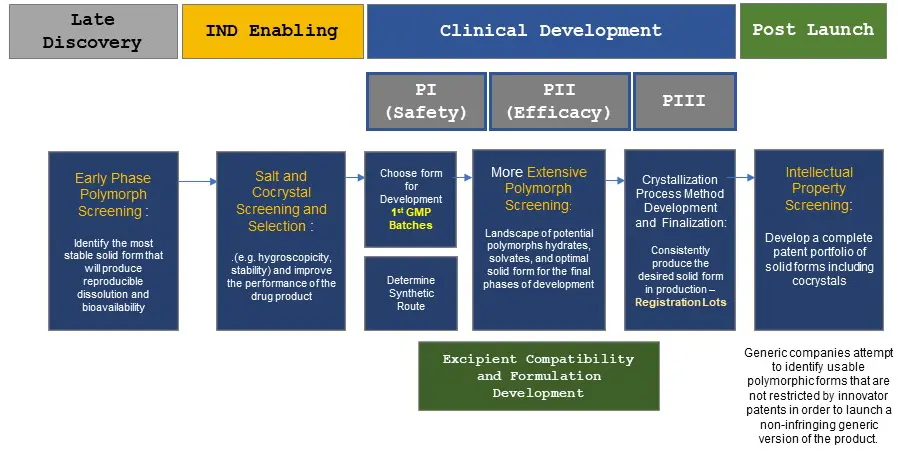
Candidate selection
Run targeted polymorph, hydrate, solvate, salt/cocrystal, and ASD feasibility work; begin thermodynamic ranking.
Preferred developable form, fallback path, and known hydrate, solvate, salt, cocrystal, or ASD risks.
Preclinical tox / Phase I
Lock a form-control strategy; stress material against humidity, vehicle, slurry, milling, compression, and storage.
Reproducible cGMP form, process sensitivity statement, and method that confirms intended form.
Phase II/III / commercial
Complete broader screening; qualify release and stability methods; control process transfer, seeding, packaging, and lifecycle risks.
Control strategy linking form, process, specs, stability, packaging, site transfer, and lifecycle/IP decisions.
Thermodynamics, kinetics, and late surprises
Early discovery frequently samples kinetic products because rapid precipitation, evaporation, short aging, and limited material favor accessible forms. Development pressure changes the experiment: time, scale, humidity, thermal excursions, solvents, excipients, mechanical stress, and seeding can overcome kinetic barriers.
Monotropic systems have one thermodynamic winner across the relevant temperature range. Enantiotropic systems switch the thermodynamic winner at a transition temperature below melting. The relationship should not be inferred from melting point alone; DSC, slurry conversion, temperature-dependent solubility, van't Hoff analysis, or other thermodynamic evidence is needed.
The practical question is not just which form is lowest in free energy under one laboratory condition. It is whether the selected form will remain the controlled form under the program's process, packaging, storage, formulation, and analytical conditions.
When a new polymorph appears during development
A late-appearing form should be confirmed, reproduced, and evaluated in proportion to its process exposure and potential effect on stability, dissolution, manufacturability, analytical control, regulatory commitments, or intellectual property. Discovery does not automatically require reformulation or a routine specification.
The late-polymorph risk guide provides a stepwise decision pathway, evidence requirements by development stage, immediate-review red flags, and the deliverables expected from a defensible investigation.
How Triclinic scopes polymorph screening
Polymorph screening should be scoped to the decision gate. A candidate-selection screen, a cGMP form-control screen, a prior-art reproduction project, and a lifecycle/IP search should not be the same package.
Triclinic prioritizes diversity of sample-generation conditions, careful interpretation, retained-sample comparisons, and orthogonal confirmation over simple experiment count. The output should state what forms are known, how they interconvert, which form is preferred, what risks remain, and how the form should be monitored.
Define the development decision. Identify whether the program needs early risk assessment, tox/clinical form selection, cGMP production support, formulation troubleshooting, regulatory documentation, or IP coverage.
Choose form-generation conditions. Use solvent crystallization, slurry competition, humidity and temperature stress, thermal methods, grinding, solvent-drop experiments, sonication, vapor exposure, and unusual nucleation conditions as appropriate to the compound.
Characterize and rank forms. Apply XRPD, DSC/TGA, Raman/IR, microscopy, DVS, Karl Fischer, chromatography, SCXRD, MicroED, solid-state NMR, and thermodynamic experiments only where they answer the form-selection question.
Deliver a risk and control recommendation. Report preferred form, known polymorphs, hydrates and solvates, interconversion routes, thermodynamic evidence, process sensitivities, and monitoring recommendations for the next stage.
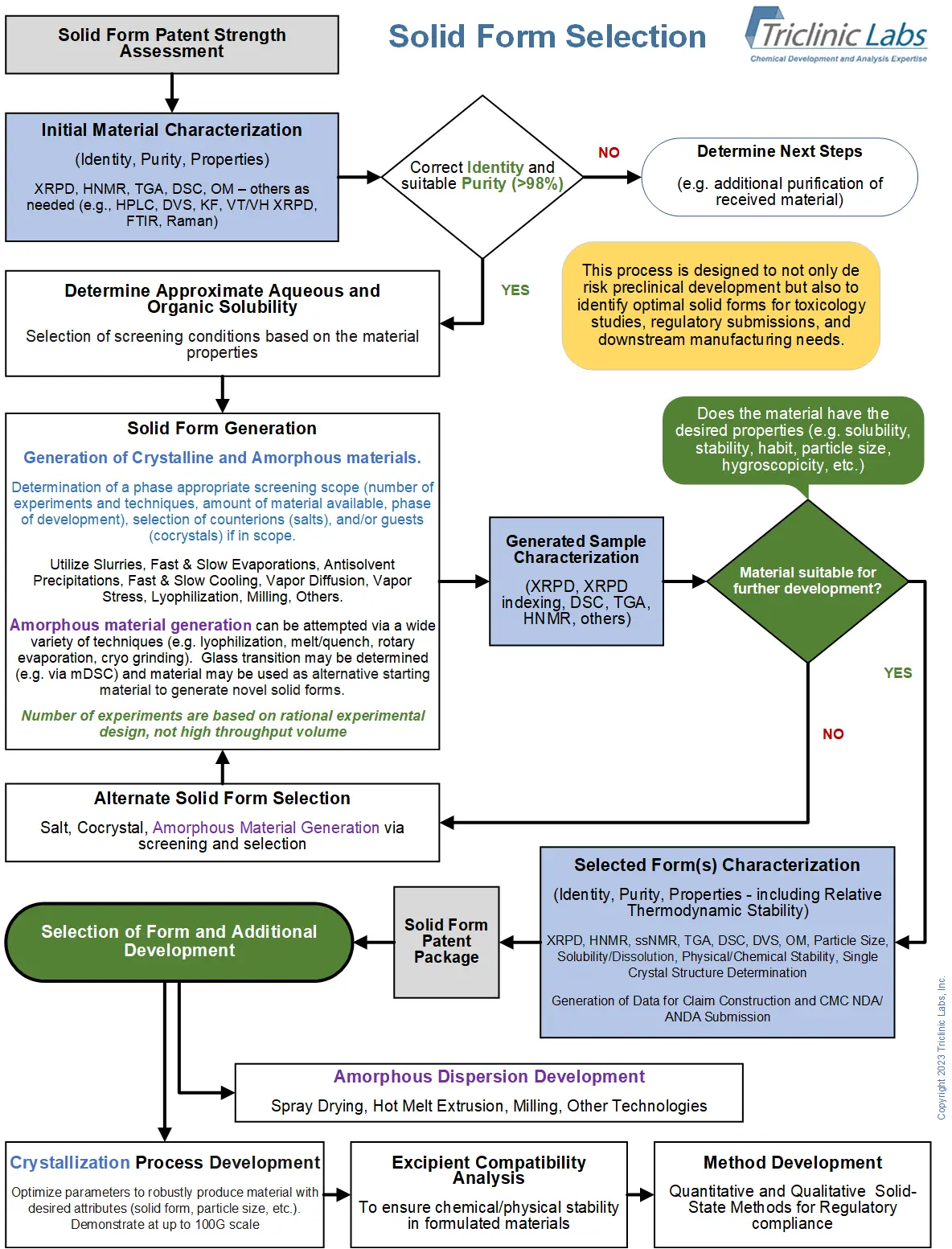
Solid form development decision tree
Use this decision tree to connect form selection, form control, formulation, process development, method development, release testing, stability, and lifecycle risk before the examples and publications section.
Screen the kinetic and thermodynamic landscape, not just the easy crystallizations
Polymorph work should deliberately sample both kinetic and thermodynamic space. Supersaturation, solvent functionality, polarity, hydrogen bonding, water mixtures, temperature, aging time, mechanical stress, and seed exposure can all influence which form appears.
High-throughput experiment count can create false confidence if the screen repeatedly samples the same accessible pathway. A useful polymorph screen is judged by whether it explores the pathways relevant to the molecule, process, dosage form, and IP objective, then scales and characterizes unique forms before property comparisons.
Decision signal
What to test
Actionable output
Kinetic forms
Rapid precipitation, antisolvent addition, grinding, melt crystallization, and stress conditions can reveal forms that matter during processing.
Use the findings to flag process sensitivity and disappearing-form risk.
Thermodynamic ranking
Slurry aging, competitive experiments, temperature-dependent solubility, and water-activity boundaries identify stable forms and reversals.
Use ranking to support long-term form selection and control.
CSP support
Computational crystal structure prediction can guide the search, but energy gaps, solvent effects, flexibility, and kinetic accessibility limit it.
Treat CSP as a guide, not final evidence of accessible forms.
Examples and Publications.
Examples, publications, and source-backed materials
What Most Contract Research Groups Won't Tell You About Solid Form Screening
Authors: Shawn C. Comella and Aeri Park, Ph.D.
Publication date: Q3 2026
Descriptive abstract: This application note explains why experiment count is a weak measure of solid-form screening quality. It presents a risk-based, stage-appropriate framework for polymorphs, hydrates, solvates, salts, cocrystals, and amorphous forms, and connects screening design, thermodynamic ranking, orthogonal characterization, and control strategy to the development decision.
In situ observation of Theophylline anhydrous forms II, III, V, and I* using Variable-Temperature, Variable-Relative Humidity X-ray powder diffraction
Author: Stephan X. M. Boerrigter and Blaise A. F. Mibeck
Publication date: September 2023
Descriptive abstract: This application note uses variable-temperature, variable-relative-humidity XRPD to observe theophylline phase behavior across temperature and humidity conditions. It demonstrates how in situ diffraction can reveal polymorphic transitions, dehydrated-hydrate behavior, and temperature/RH-dependent phase relationships that matter for screening, storage, and process control.
A Comprehensive Approach for Solid Form Selection in Preclinical Development and Beyond
Author: Melanie Bevill, Chris Seadeek, Nico Setiawan, Shawn Comella, Blaise Mibeck, and Steef Boerrigter
Publication date: November 2023
Descriptive abstract: This application note frames solid-form selection as a decision-driven process that compares polymorphs, salts, cocrystals, amorphous materials, hydrates, solvates, and other non-crystalline forms against developability criteria. It emphasizes crystallinity, stability, solubility, hygroscopicity, manufacturability, regulatory needs, financial risk, and intellectual property strategy rather than a high-throughput experiment count.
Variable-temperature and variable-relative-humidity XRPD is useful when polymorph, hydrate, or phase-transition behavior depends on the temperature/RH space that the API will experience in storage or processing.
VT/VRH XRPD analysis of theophylline. Brief abstract: The animation uses variable-temperature, variable-relative-humidity X-ray powder diffraction to track theophylline as it is heated from 5 to 80 °C under controlled relative humidity. XRPD patterns were collected from 5° to 20° 2θ every seven minutes; the 5% RH waterfall plot shows the onset of dehydrated-hydrate form I, subsequent form III, and stable anhydrous form II before the final 80 °C condition. This example illustrates how in situ diffraction can expose polymorph and hydrate-transition pathways that may matter during storage, processing, or troubleshooting. Source: Triclinic Labs, “VT/VRH XRPD analysis of theophylline”.
Development implication: if lot-to-lot PK, dissolution, stability, or process behavior changes, run form ID on retained lots and compare residual solids after performance testing.
Choose the next solid-form development step
Use the screening evidence to select the next decision without returning to the service hub. Triclinic can connect form selection, crystallization and scale-up, analytical characterization, manufacturing troubleshooting, and phase-appropriate cGMP support in one program.
Form selection
Compare polymorph, salt, cocrystal, and amorphous options against stability, solubility, manufacturability, and development-stage risk.
Select the orthogonal methods needed to identify the form, monitor conversion, and support phase-appropriate release, stability, and comparability work.
When should pharmaceutical polymorph screening be completed before an IND?▾
A phase-appropriate screen should begin before an Investigational New Drug (IND) submission whenever possible, so the selected form, known alternatives, conversion risks, and analytical controls can inform toxicology, formulation, stability, and early clinical supply. Additional screening may be appropriate as the process, formulation, and development stage change.
What determines the quality of a polymorph screen?▾
Quality depends on the diversity and relevance of the conditions, not the raw experiment count. A strong screen explores solvent history, water activity, temperature, slurry competition, mechanical stress, seeding, isolation, and storage conditions that matter to the molecule and development stage, then follows unexpected behavior with scientist-directed experiments.
What material is required for pharmaceutical polymorph screening?▾
Triclinic scopes the screen around available active pharmaceutical ingredient (API), purity, salt or free-form state, prior solid-form data, solubility, stability, and the next development decision. Early screens can be designed around limited material; broader secondary and characterization work generally requires more API and representative process material.
What is the difference between primary and secondary polymorph screening?▾
A primary screen surveys diverse solvents and crystallization conditions to identify likely forms and early risk. A secondary screen uses what was learned to challenge the landscape more deeply, investigate thermodynamic relationships and interconversion, and support form selection and control.
How are hydrates and solvates evaluated during polymorph screening?▾
Experiments vary water activity, solvent composition, temperature, humidity, isolation, drying, and storage conditions. XRPD, thermal analysis, dynamic vapor sorption, Karl Fischer titration, spectroscopy, and other evidence distinguish true hydrates or solvates from surface moisture, residual solvent, mixtures, and transformation products.
Can a polymorph screen prove that no other forms exist?▾
No. A screen defines the forms found under the conditions studied and reduces uncertainty; it cannot prove that an undiscovered form will never appear. The output should state residual risk and the control strategy appropriate to the development stage.
How is a form selected after polymorph screening?▾
The preferred form is selected by balancing thermodynamic and physical stability, solubility and dissolution, manufacturability, process sensitivity, formulation performance, analytical control, and intellectual property considerations. The recommendation also identifies known alternative forms and residual risks.
What happens when a new polymorph is discovered during development?▾
The form should be confirmed, classified, and assessed in proportion to risk. The critical questions are whether it is reproducible, whether it can occur in the proposed manufacturing process or drug product, and whether it affects stability, manufacturability, dissolution, exposure, analytical control, or intellectual property. Discovery does not automatically require reformulation or routine specification. Use the late-polymorph risk guide to review the decision pathway and evidence requirements.
Talk to a Triclinic Labs scientist about Polymorph Screening and Selection Services
Send the polymorph question, material history, screening data, known forms, process and storage stresses, formulation context, and decision timeline. Triclinic can help determine which solid-form evidence is relevant to the project, whether additional screening or thermodynamic ranking is needed, and how the selected form should be monitored through development. For a connected program from candidate nomination through IND, explore the candidate-to-IND solid-form development pathway.