What is this?
cGMP particle-size analysis measures particle-size distributions, typically by laser diffraction or microscopy/image analysis, under a controlled method suitable for release, stability, comparability, or transfer.

Particle-size distribution can affect dissolution, blend uniformity, filtration, processability, content uniformity, and product performance. A defensible result depends on representative sampling, appropriate dispersion conditions, control of agglomeration, suitable optical assumptions, and a method that reflects how the material behaves. Triclinic Labs develops, validates, verifies, transfers, and performs cGMP particle-size analysis using laser diffraction and complementary techniques with qualified instrumentation and complete regulated documentation.
Our scientists select and interpret the method around the material and quality decision rather than forcing every sample through a standard instrument setting.
The content of this page has been scientifically reviewed by Nico Setiawan, Ph.D., Analytical Director at Triclinic Labs · Updated 8/1/2026


cGMP particle-size analysis measures particle-size distributions, typically by laser diffraction or microscopy/image analysis, under a controlled method suitable for release, stability, comparability, or transfer.
Use it when particle size affects dissolution, bioavailability, content uniformity, flow, filtration, blend behavior, device performance, or batch disposition.
Results depend strongly on dispersion medium, refractive index, obscuration, sonication, sample prep, agglomeration, shape, and wet/dry method choice.
Method development and validation need more material than a one-time ID test because they require replicates, robustness, precision, intermediate precision, and sometimes transfer studies.
Complementary techniques include optical microscopy, static image analysis, scanning electron microscopy (SEM), Brunauer-Emmett-Teller (BET) specific surface area, powder-flow testing, X-ray powder diffraction (XRPD), Raman spectroscopy, and dissolution testing. They distinguish size-distribution effects from particle shape, surface area, solid form, chemistry, and product performance.
FDA cares that the PSD method is specific to the intended distribution and that method parameters are controlled under USP <429>, <776>, <1174>, or other applicable expectations where relevant.
Common mistakes include using exploratory data as release evidence, validating the wrong matrix, ignoring sample preparation, under-documenting controls, relying on one technique when orthogonal evidence is needed, or failing to define the decision before testing.
Triclinic uses cGMP particle-size analysis when particle-size distribution is part of a release, stability, comparability, process-control, or specification decision. Real-world applications include laser diffraction, microscopy, or sieve-based methods for APIs, excipients, and formulated materials where sampling, dispersion, method suitability, validation or verification, and controlled reporting determine whether the result can support quality decisions.
Exploratory data can help choose a method, but release or filing-support data require controlled execution. The method must be suitable for the matrix, the quality attribute must be defined, reference standards and controls must be appropriate, and the report or CoA must say only what the data support.
| cGMP concern | Why it matters | Practical control |
|---|---|---|
| Method status | Exploratory, verified compendial, validated custom, and transferred methods have different evidence requirements. | Define status before testing and document any development, verification, validation, or transfer work. |
| Sample matrix | Specificity can fail in real drug product, excipient, talc, low-dose, or complex solid mixtures. | Use representative material, placebo/matrix controls, spike studies, or orthogonal methods where needed. |
| Data integrity | Release or stability results must survive QA review, audit, and regulatory scrutiny. | Use controlled records, system suitability, analyst review, deviations/OOS process, and traceable calculations. |
The table below lists the specific platforms, brands, models, software, detectors, and capability notes relevant to this cGMP service area.
| Instrument or platform | Brand, model, software, or detector | Additional capabilities and use |
|---|---|---|
| Laser diffraction PSD | Malvern Mastersizer 3000 v.3.70 with Malvern Access Configurator v.2.20 | Particle-size distribution by volume-equivalent sphere diameter; dry range 0.1-3500 µm and wet range 0.01-1500 µm. |
| cGMP PSD methods | Malvern Mastersizer 3000 platform with method-development, verification, transfer, validation, and release-testing workflows | Validated particle-size methods, batch release results, and cGMP/non-GMP comparability studies. |
| Particle-specific Raman identification | Renishaw inVia / Thermo FT-Raman / Ondax low-frequency Raman platforms; 785 nm, 1064 nm, and THz-Raman options | Targeted Raman analysis of selected particles to connect particle morphology with chemical identity or composition. This is a scientist-directed microscopy and Raman workflow and should not be interpreted as automated analysis of every detected particle. |
| Optical and digital morphology | Leica M80, Leica DM2500P, Keyence VHX-2000E, and Pax-it2! v.1.4.3 software | Particle-shape, agglomeration, habit, and topography observations to complement laser diffraction. |
| SEM/EDX morphology | Thermo Phenom XL SEM/EDX and FEI Quanta 3D FEG | High-resolution particle morphology and elemental confirmation for particles, contaminants, and agglomerates. |
This example shows why particle-size methods used for cGMP release must control dispersion, obscuration, optical properties, and reporting metrics rather than relying on a single D50 value. A regulated particle-size program may include wet or dry particle-size analysis, particle distribution, counting, method development, verification, transfer, and release testing, including support for USP chapters covering laser diffraction, bulk/tapped density, crystallinity, microscopy, powder flow, and water-solid interactions.
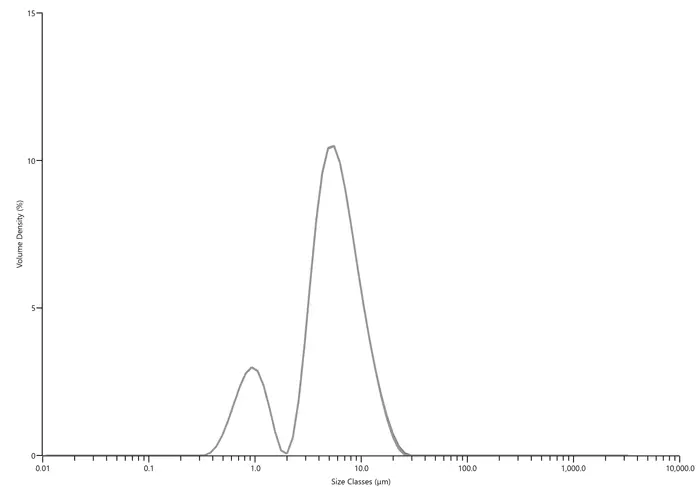
These examples cite Triclinic source documents, regulatory guidances, or literature relevant to this cGMP service. Download buttons are positioned at the bottom-left of each example.
Author: International Council for Harmonisation / FDA
Publication date: 2024
Abstract: These harmonized guidances describe validation and development principles for analytical procedures used to assess drug-substance and drug-product quality. They anchor expectations for specificity, accuracy, precision, range, robustness, lifecycle management, and fit-for-purpose method evidence in cGMP work.
Author: Anne Virden, Pharmaceutical Technology
Overview: Sampling, wet and dry dispersion, optical models, concentration, measurement duration, repeatability, and reproducibility.
For exploratory characterization and non-cGMP method development, see Particle-Size Distribution Testing and Method Development.
Use cGMP NMR for identity, purity, qNMR, reference-material verification, method development, validation, and release testing.
View serviceUse cGMP XRPD for solid-form identification, polymorph or phase quantitation, crystallinity, method validation, release, and stability support.
View serviceUse cGMP DSC and TGA to evaluate melting, desolvation, dehydration, glass transitions, degradation, and thermal material control.
View serviceUse cGMP Raman and FTIR for raw-material ID, solid-form differentiation, mapping, contaminant ID, and validated spectroscopic methods.
View serviceUse cGMP microscopy and particle morphology evidence for identification, particle shape, foreign-material work, and regulated investigations.
View serviceUse verified or validated methods to support batch disposition, CoA issuance, stability testing, and regulatory documentation.
View serviceParticle size affects surface area, dissolution, powder flow, blending, segregation, content uniformity, compaction, suspension behavior, and deposition in some dosage forms. Smaller particles often dissolve faster, but excessive size reduction can increase agglomeration, electrostatic behavior, moisture uptake, poor flow, amorphization, and instability. The target distribution should therefore reflect the formulation, manufacturing process, and route of administration.
Laser diffraction is generally preferred for rapid, statistically robust measurement of an overall particle-size distribution across a broad range when particles can be dispersed reproducibly. Image analysis is preferred when particle shape, aspect ratio, agglomeration, individual-particle dimensions, or visually distinct populations matter. The techniques measure different attributes and are complementary rather than interchangeable.
D10, D50, and D90 are percentile diameters that summarize the fine, central, and coarse regions of a cumulative distribution. D10 is the diameter below which 10% lies, D50 is the median, and D90 is the diameter below which 90% lies. Their meaning depends on the technique and weighting basis, and they do not reveal distribution shape, modality, morphology, aggregation, or rare extreme particles.
Particle shape influences powder flow, packing, blending, filtration, drying, compaction, suspension behavior, dissolution, aerodynamic performance, and particle-size measurements. Needles, plates, fibers, spheres, and irregular particles of similar nominal size can behave differently because of their aspect ratio, surface area, orientation, contact mechanics, and interparticle interactions.
Agglomeration can make material appear coarser because many techniques measure the dispersed entities present during analysis, not the primary particles. Sonication, stirring, surfactant, air pressure, concentration, sample history, and measurement time can change the result. Inadequate dispersion overestimates primary-particle size, while excessive energy may fracture particles and underestimate process-relevant size.
Image-based methods are best suited to measuring needle length, width, and aspect ratio directly. Static or dynamic image analysis, optical microscopy, polarized-light microscopy, and scanning electron microscopy may be used depending on the required resolution and particle count. Laser diffraction can provide bulk-distribution data, but it cannot independently distinguish length from width, orientation, breakage, or agglomeration.
Particle size describes particle dimensions or an equivalent diameter, while morphology describes shape, aspect ratio, surface texture, angularity, porosity, crystal habit, and structural appearance. Materials with the same D50 may behave differently if one contains spheres and the other needles, plates, porous particles, or agglomerates. Size and morphology are complementary attributes.
Particle characterization links size, shape, surface properties, density, porosity, and agglomeration state to dissolution, blending, flow, compaction, suspension stability, aerosol performance, content uniformity, and process reproducibility. It helps identify material risks, select processing conditions, establish specifications, compare suppliers and batches, and determine whether performance changes arise from the formulation, manufacturing process, API, or excipients.

Send the sample type, intended use of the data, method or monograph if available, specification, matrix, timeline, and whether the work is exploratory, cGMP, validation, transfer, stability, release, or investigation support.