Molecular structure
Determine molecular identity, connectivity, stereochemical relationships, or an impurity or degradant structure using solution-state and multidimensional NMR.
Explore molecular structure support
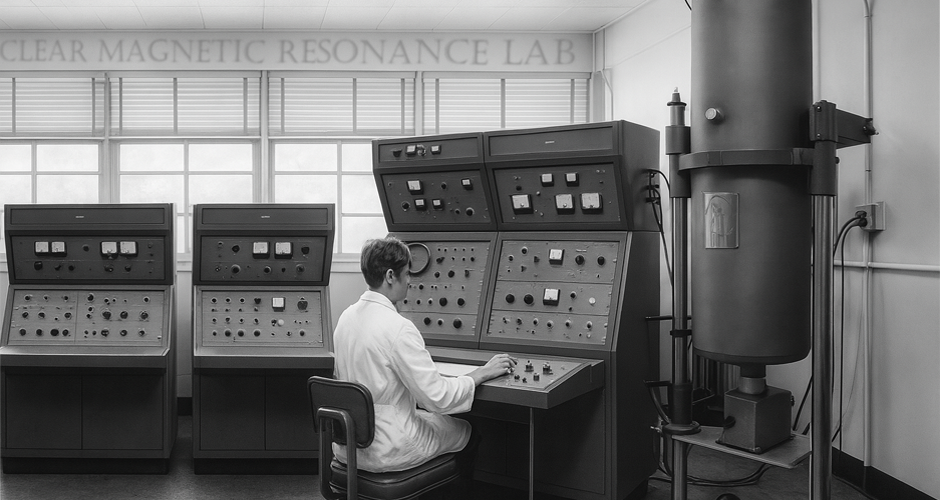
Use solution and solid-state NMR for molecular identity, connectivity, purity, formulation composition, polymorphs, amorphous forms, and API interactions.
Nuclear magnetic resonance (NMR) structure determination uses spectral evidence to establish connectivity and stereochemistry when the data support a defined molecular structure. Structure elucidation combines one-dimensional, two-dimensional, multinuclear, and complementary data to solve an unknown or incomplete structure. Confirmatory NMR tests a proposed identity or structural assignment against targeted spectral evidence.
The content of this page was scientifically reviewed by Byungsu Kwon, Ph.D., Director of NMR Services at Triclinic Labs · Updated 8/1/2026
Start with the question you need to answer. Triclinic can combine routes when molecular identity, solid-state behavior, quantitative results, and regulated testing must support the same decision.
Determine molecular identity, connectivity, stereochemical relationships, or an impurity or degradant structure using solution-state and multidimensional NMR.
Explore molecular structure supportEvaluate polymorphs, salts, amorphous materials, disorder, local chemical environments, and active pharmaceutical ingredient interactions in solid samples.
Explore solid-state NMR servicesUse quantitative nuclear magnetic resonance (qNMR) for assay, purity, reference-material verification, or component measurement with appropriate controls.
Explore quantitative NMR servicesSupport identity, purity, qNMR, method development, validation, reference-material verification, and release testing with controlled documentation.
Explore cGMP NMR servicesNMR spectroscopy supports structural identification, elucidation, and characterization of pharmaceuticals and other chemical compounds, including the identification and structural characterization of known and novel compounds.
NMR can support identity, molecular connectivity, purity, quantitation, reaction monitoring, binding, formulation characterization, and cGMP method development. Solid-state NMR adds value for polymorph identification, amorphous/crystalline materials, insoluble substances, API/excipient interactions, and materials that cannot be evaluated fully by solution methods alone.
In impurity identification, NMR helps test whether the formula and fragments proposed by HRMS are chemically plausible. In solid-form work, ssNMR can distinguish local environments in forms that are difficult by XRPD alone. In formulation or deformulation work, NMR can help assign components when chromatographic or spectral overlap creates ambiguity.
The conclusion should specify whether the NMR data prove connectivity, support a proposed structure, quantify a component, distinguish a form, or rule out alternatives.
| Question | Useful evidence | Decision output |
|---|---|---|
| Molecular identity or formula | LC/MS HR/MS, MS/MS fragments, NMR, elemental or isotope information where relevant. | Candidate formula and structure assignment with alternatives and limitations. |
| Crystal structure or absolute configuration | SCXRD, MicroED, XRPD, crystallographic refinement, spectroscopy and chemistry context. | Structure solution, unit-cell or form confirmation, stereochemical interpretation when supported. |
| Impurity or contaminant identity | Chromatography, HRMS, MicroED if crystalline, NMR if sufficient material, Raman/IR, microscopy. | Root-cause-ready identity conclusion and evidence package. |
| Solid-form or formulation ambiguity | XRPD, Raman/IR, ssNMR, DSC/TGA, microscopy, DVS, residual-solids analysis. | Phase/form assignment and control or follow-up recommendation. |

These source-backed examples connect NMR Structure Elucidation to actual Triclinic materials and peer-reviewed literature. Each example includes author, publication date, and an abstract-level explanation.
Author: Gary C. George III, Jason Vanlerberghe, and Stephan X.M. Boerrigter
Publication date: Q1 2026
Abstract: Impurity peaks often exist in trace quantities that make isolation and traditional structure elucidation difficult. HRMS provides accurate m/z and candidate formula constraints, while MicroED can determine crystal structures from nanoscale crystallites, making the combined workflow useful for rapid definitive impurity identification.
Download this WhitepaperAuthor: Royal Society of Chemistry book chapter contributors
Publication date: 2024
Abstract: This RSC chapter discusses NMR applications in drug substance and drug product development, including impurity structure elucidation during stability studies, solid-state NMR of drug products, and quantitation in formulated products. It supports the use of NMR as an orthogonal structure and formulation-characterization technique.
DownloadAuthor: Shawn C. Comella, Gary C. George III, and Steef X.M. Boerrigter
Publication date: Q2 2026
Abstract: MicroED removes the large-single-crystal bottleneck by enabling molecular structure determination directly from sub-micron crystals. Integrated with expert crystallography, XRPD, HRMS, Raman/IR, and other orthogonal methods, it functions as a mainstream structure-elucidation workflow.
Download this WhitepaperRelated structure elucidation service or orthogonal method for projects that require defensible structural evidence.
View serviceRelated structure elucidation service or orthogonal method for projects that require defensible structural evidence.
View serviceRelated structure elucidation service or orthogonal method for projects that require defensible structural evidence.
View serviceRelated structure elucidation service or orthogonal method for projects that require defensible structural evidence.
View serviceRelated structure elucidation service or orthogonal method for projects that require defensible structural evidence.
View serviceThe first technique depends on the decision, material amount, sample form, and prior data. Single-crystal X-ray diffraction is preferred when suitable crystals are available; MicroED is valuable for microcrystalline particles; NMR supports connectivity and local environment; LC/MS HR/MS supports formula and fragment evidence; Raman/IR and microscopy help connect molecular and physical identity.
Yes, many structure-elucidation workflows can be scoped around limited material, but feasibility depends on crystallinity, purity, sample matrix, detection limit, and whether the question requires definitive structure, tentative identification, or triage.
Yes, if the work is scoped to the evidentiary standard required. Reports should state what the data prove, what remains ambiguous, and what additional evidence would change the conclusion.
No single method answers every structural question. Orthogonal evidence reduces misassignment risk by connecting formula, connectivity, phase identity, crystal structure, purity, sample history, and matrix behavior.
Yes. Depending on molecular size, concentration, labeling, solubility, and spectral complexity, NMR can support peptide identity, conformation, dynamics, interactions, aggregation, purity, and concentration.
Requirements depend on whether the work uses solution-state or solid-state NMR, the nuclei and experiments required, concentration, solubility, molecular weight, mixture complexity, and instrument sensitivity. Provide the proposed structure, sample history, available mass, solvent information, formulation or matrix details, and prior spectra so feasibility and the minimum useful experiment set can be assessed.
NMR provides connectivity, stereochemical, and local-environment evidence. High-resolution mass spectrometry (HRMS) adds accurate-mass, formula, isotope, and fragmentation evidence. Single-crystal X-ray diffraction (SCXRD) or microcrystal electron diffraction (MicroED) can provide an atomic-level crystal structure when suitable crystalline material is available. These methods are combined when one technique cannot resolve identity, stereochemistry, impurity structure, or crystal-structure ambiguity by itself.

Share the material, sample amount, solvent or solid-state constraints, prior spectra, impurity or structure question, and reporting requirements.