
Unknown Contaminant Identification
Combine elemental results with molecular identity, morphology, and microscopy when the unknown is a discrete particle or residue.

Elemental analysis can answer different questions depending on the technique and sample form. ICP-MS is appropriate for sensitive quantitative elemental impurity work after suitable preparation. SEM/EDX is useful when the question is localized to a particle, coating, surface feature, filler, corrosion product, or inorganic inclusion. XRF and other non-destructive methods can be useful for bulk or screening questions where sample preservation matters.
For a broader comparison of ICP-MS, SEM/EDX, XRF, PIXE, and related capabilities, visit Elemental Analysis Testing Services.
For pharmaceutical materials, elemental results may support ICH Q3D or USP <232>/<233> elemental-impurity risk, foreign-particle identification, raw-material verification, inorganic excipient assessment, catalyst residue questions, corrosion or wear investigations, and source comparisons.
Elemental quantification projects are matched to the technique and instrument that best fit the sample matrix, required detection limits, spatial-resolution needs, and reporting objective.
| Instrument manufacturer | Model / platform | Notes |
|---|---|---|
| Thermo | iCAP RQ ICP-MS HPLC-ICP Interface | Single-quadrupole ICP-MS platform for trace elemental analysis across a range of sample types; used for method development, validation, and release testing. Our advanced HPLC-ICPMS capability delivers precise elemental speciation with exceptional sensitivity and selectivity, making it an ideal solution for applications in fields such as pharmaceutical and environmental sciences. We accurately quantify trace metal impurities and species in pharmaceuticals to support ICH Q3D compliance and ensure product safety. For environmental testing, we specialize in arsenic speciation, distinguishing between toxic inorganic forms (As(III) and As(V)) and less harmful organic species in water, soil, and commercial product samples. With ultra-low detection limits, robust performance in complex matrices, and reliable, regulatory-ready data, our HPLC-ICPMS services provide the critical insights you need for quality control, risk assessment, and confident decision-making. |
| Thermo | Phenom XL SEM/EDX | SEM/EDX platform with integrated elemental and backscattered-electron detection for localized particle analysis, inorganic contaminant work, and elemental mapping. |
| Panalytical | Epsilon 4 ED-XRF | ED-XRF spectrometer for elemental analysis from carbon (C) to americium (Am), with concentration ranges from sub-ppm levels to 100 wt% depending on sample and method. |
Elemental quantification projects should be scoped around the decision the data must support. ICP-MS is the better fit when the question is sensitive bulk quantification of trace elemental impurities. SEM/EDX is the better fit when the question is localized composition: what a particle, inclusion, coating, residue, or surface feature contains and whether that composition is consistent with a suspected source.
For quantitative elemental-impurity questions, Triclinic can use ICP-MS to support low-level elemental analysis across pharmaceutical raw materials, intermediates, excipients, finished products, and investigation samples. ICP-MS is appropriate when the concern is concentration rather than only identity, including metals and selected non-metals at ppm, ppb, or lower levels after suitable sample preparation.
A typical case-study workflow begins with the route of administration, maximum daily dose, material type, and suspected elemental risk. The method is then selected to produce defensible concentration data for the elements of concern. For pharmaceutical work, this may include elements addressed in USP <232> / <233> and ICH Q3D elemental-impurity risk assessments, with interpretation tied back to the sample matrix, preparation approach, reporting limits, and the quality decision being made.
| Question | ICP-MS contribution | Practical output |
|---|---|---|
| Are trace metals present above a relevant threshold? | Sensitive quantitative measurement of target elements after appropriate digestion or preparation. | Element-by-element concentration results with reporting limits and method notes. |
| Is a raw material, excipient, or product consistent with an elemental-impurity control strategy? | Targeted elemental impurity measurement for the elements and limits relevant to the material and use case. | Data that can be reviewed against client-specified, compendial, or risk-based limits. |
| Could a low-level elemental signal support a broader contamination investigation? | Bulk trace-element results that can be compared to suspected sources or paired with localized SEM/EDX findings. | A ranked set of elemental findings that helps determine whether further particle-level or source-comparison work is warranted. |
SEM/EDX is valuable when elemental composition must be tied to a physical feature. In the elemental-analysis example from Triclinic's existing technical material, SEM imaging and EDX were used to evaluate a foreign particle by spot and regional elemental analysis. The example shows why localized analysis matters: one region demonstrated the copper substrate, while the inclusion body showed aluminum, oxygen, copper, lanthanum, and carbon. A second smaller particle showed carbon, silicon, and copper.
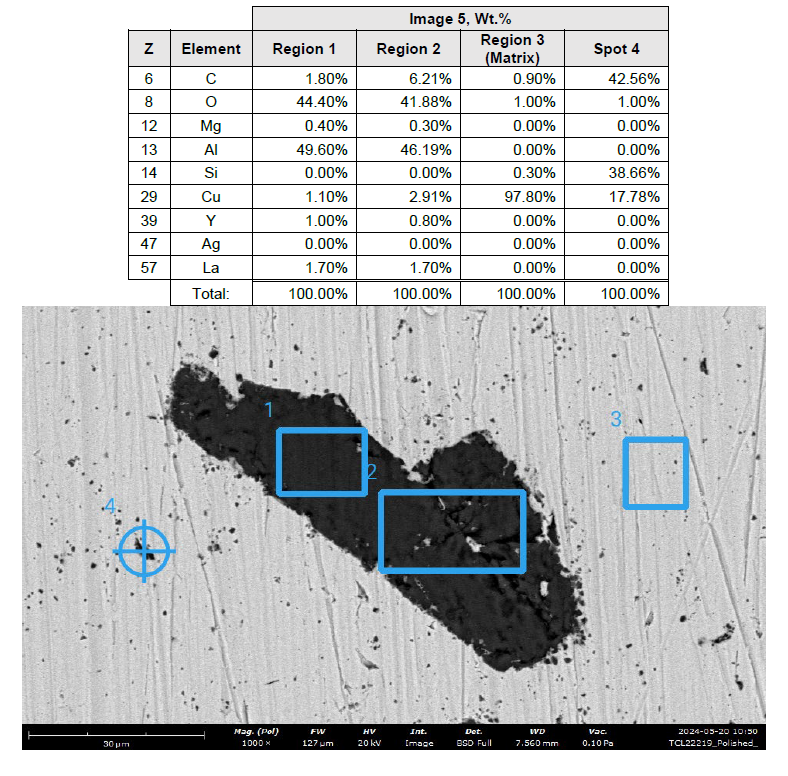
This type of SEM/EDX evidence can support root-cause investigations, supplier or process-contact comparisons, inorganic inclusion analysis, corrosion or wear investigations, and decisions about whether a particle is chemically consistent with a suspected source.
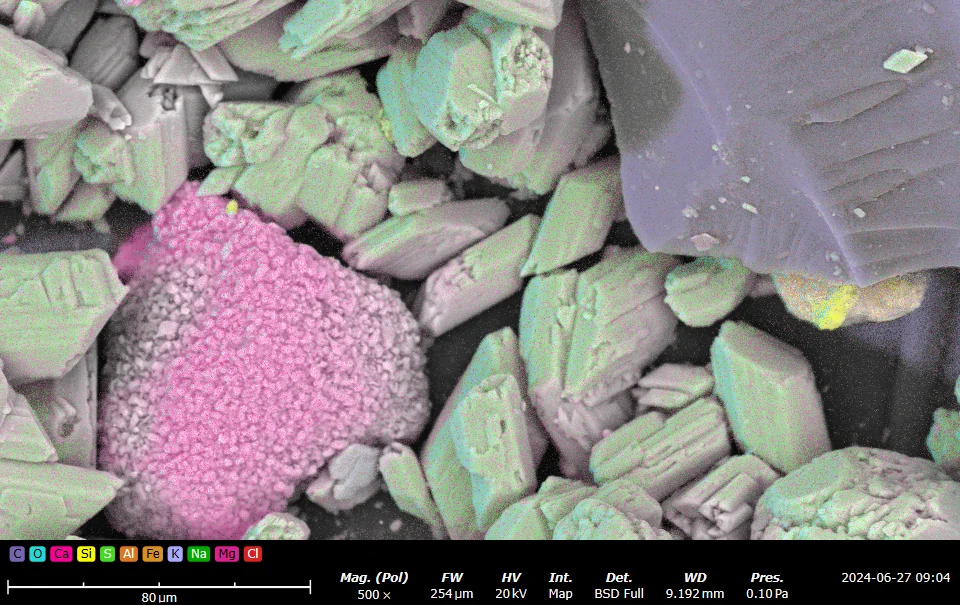
Elemental mapping is useful when composition and location both matter. In the synthetic-sample example from the same Triclinic elemental-analysis source, EDX false-color imaging distinguished calcium carbonate, calcium sulfate, and graphite domains. The example illustrates how elemental mapping can convert a visually complex field into interpretable component distribution data.
| Technique or platform | Information produced | Why it matters |
|---|---|---|
| Optical and digital microscopy | Visual morphology, dimensions, surface features, color, layering, and sample-selection context. | Documents the evidence before destructive testing and helps select specific particles or regions for analysis. |
| Raman microscopy and chemical mapping | Molecular fingerprints and spatial distribution of many APIs, excipients, pigments, polymers, and crystalline components. | Useful for suspect-versus-authentic comparisons, coating/core analysis, layered systems, and localized unknowns. |
| FTIR and IR microspectroscopy | Polymer, organic, excipient, adhesive, fiber, film, and residue identification. | Often strong for particles, fibers, packaging materials, cap liners, label adhesives, and contact-material comparisons. |
| SEM/EDX | High-resolution morphology plus elemental composition and elemental maps. | Critical for inorganic particles, fillers, talc-related signals, metals, corrosion, pigments, and source comparisons. |
| LC/MS, GC/MS, chromatography, NMR, or ICP-MS | Targeted or investigative molecular, volatile/semi-volatile, structural, or trace-element information. | Added when direct microanalysis is not enough or when confirmation, quantitation, or structural assignment is required. |
Combine elemental results with molecular identity, morphology, and microscopy when the unknown is a discrete particle or residue.
Address sampling, blanks, preparation, matrix interference, and sensitivity when an elemental target is present at low abundance.
Compare elemental profiles with raw materials, catalysts, process-contact surfaces, packaging, and environmental sources.
Evaluate elemental or inorganic findings associated with packaging, devices, closures, and other product-contact materials.
Bulk methods such as inductively coupled plasma mass spectrometry or X-ray fluorescence measure an average elemental result for the prepared sample. Scanning electron microscopy with energy-dispersive X-ray spectroscopy measures selected particles or regions and can show where an element is localized.
Yes. Good and suspect lots, raw materials, catalysts, process-contact surfaces, packaging, residues, and environmental materials can be compared. A similar elemental profile can support a source hypothesis, but source attribution normally also requires morphology, location, process history, or other evidence.
The amount depends on the technique, matrix, expected concentration, detection limit, digestion or preparation needs, and whether the sample is representative. Individual particles may be examined locally, while defensible bulk quantification generally requires enough material for representative preparation and controls.
Inductively coupled plasma mass spectrometry is suited to sensitive bulk quantification after suitable preparation. X-ray fluorescence supports nondestructive elemental screening and bulk comparisons. Scanning electron microscopy with energy-dispersive X-ray spectroscopy is useful when elemental composition and location within a particle or region both matter.

Share the sample matrix, available amount, expected elements and concentration range, required detection or quantitation limits, suspected sources, comparison materials, and whether the result must represent the bulk sample or a selected particle or region.