Use diffraction and crystallographic interpretation to turn solid-form observations into structural evidence.
Use diffraction and crystallographic interpretation to turn solid-form observations into structural evidence.
Determine crystal structures, unit cells, polymorph assignments, and structure-property relationships using diffraction and orthogonal solid-state evidence.
The content of this page has been scientifically reviewed by Steef Boerrigter, Ph.D., Research Fellow & Head Crystallographer at Triclinic Labs · Updated 8/1/2026
Crystal structure is a decision-quality endpoint
The full elucidation of a crystal structure determines the molecular structure, conformation, hydrogen bonding, counterion or coformer interactions, hydrate/solvate inclusion, and absolute configuration of chiral compounds.
XRPD, SCXRD, and MicroED provide complementary methods for crystallographic analysis, phase identification, quantitative phase analysis, and lattice-parameter measurement. Their results become more useful when interpreted alongside thermal, spectroscopic, microscopic, and chemical evidence.
When to escalate from pattern matching to structure solution
A fingerprint match can identify a known polymorph, but it is often insufficient for salt/cocrystal classification, absolute configuration, patent examples, low-level impurity assignments, or unexpected phase behavior. Structure solution is appropriate when the project needs atomic-level evidence or a defensible explanation for structure-property behavior.
If large single crystals can be obtained, SCXRD can directly solve structure and configuration. If only microcrystalline powder is available, MicroED can remove the crystal-growth bottleneck and provide structure information from particles far smaller than required for SCXRD.
How the evidence fits together
Question
Useful evidence
Decision output
Molecular identity or formula
LC/MS HR/MS, MS/MS fragments, NMR, elemental or isotope information where relevant.
Candidate formula and structure assignment with alternatives and limitations.
Crystal structure or absolute configuration
SCXRD, MicroED, XRPD, crystallographic refinement, spectroscopy and chemistry context.
Structure solution, unit-cell or form confirmation, stereochemical interpretation when supported.
Impurity or contaminant identity
Chromatography, HRMS, MicroED if crystalline, NMR if sufficient material, Raman/IR, microscopy.
Root-cause-ready identity conclusion and evidence package.
Phase/form assignment and control or follow-up recommendation.
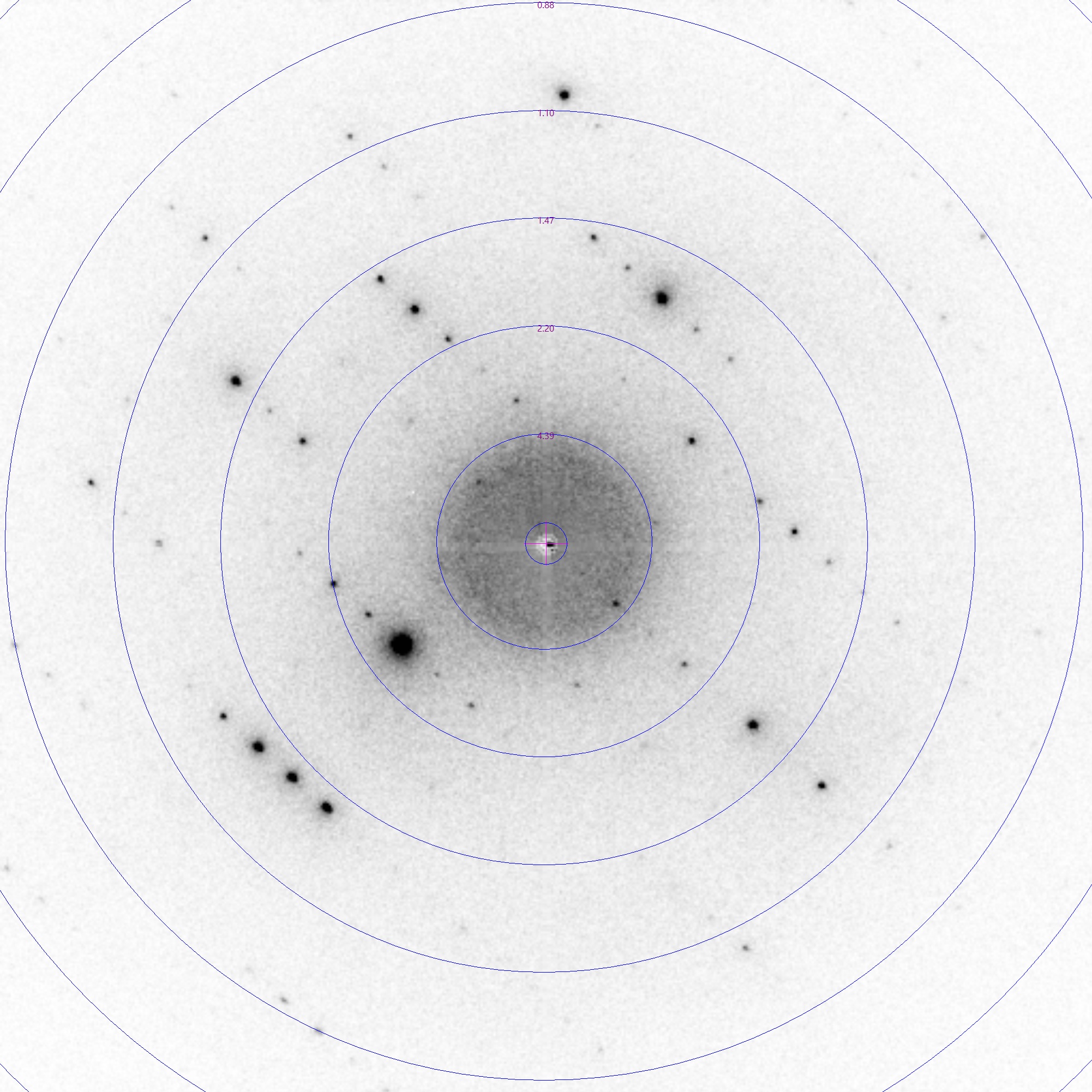
MicroED single-crystal diffraction-pattern example
MicroED single-crystal diffraction pattern showing diffracted intensities. For structure solution, hundreds to thousands of such patterns are collected at different crystal orientations. Source: Comella, George, and Boerrigter, Integrating Microcrystal Electron Diffraction as a Mainstream Work Tool in Solid Form Development and Structure Elucidation, Triclinic Labs white paper, Q2 2026.
Examples and Publications.
These source-backed examples connect Crystal Structure Determination to actual Triclinic materials and peer-reviewed literature. Each example includes author, publication date, and an abstract-level explanation.
Integrating Microcrystal Electron Diffraction as a Mainstream Work Tool in Solid Form Development and Structure Elucidation
Author: Shawn C. Comella, Gary C. George III, and Steef X.M. Boerrigter
Publication date: Q2 2026
Abstract: MicroED removes the large-single-crystal bottleneck by enabling molecular structure determination directly from sub-micron crystals. Integrated with expert crystallography, XRPD, HRMS, Raman/IR, and other orthogonal methods, it functions as a mainstream structure-elucidation workflow.
The CryoEM Method MicroED as a Powerful Tool for Small Molecule Structure Determination
Author: Christopher G. Jones, Michael W. Martynowycz, Johan Hattne, Tyler J. Fulton, Brian M. Stoltz, Jose A. Rodriguez, Hosea M. Nelson, and Tamir Gonen
Publication date: 2018
Abstract: This ACS Central Science paper reports MicroED as a route to routine and unambiguous structural determination of small organic molecules from simple powders and nanocrystals with minimal preparation. It is a useful literature anchor for why MicroED belongs in modern small-molecule structure-elucidation workflows.
Abstract: This pharmaceutical-materials example demonstrates how mechanochemistry and MicroED can be combined when suitable single crystals are difficult to obtain. It supports using MicroED as a practical structure-elucidation tool for pharmaceutical salts and solid forms.
Which structure elucidation technique should be used first?▾
The first technique depends on the decision, material amount, sample form, and prior data. Single-crystal X-ray diffraction is preferred when suitable crystals are available; MicroED is valuable for microcrystalline particles; NMR supports connectivity and local environment; LC/MS HR/MS supports formula and fragment evidence; Raman/IR and microscopy help connect molecular and physical identity.
Can Triclinic work with very small amounts of material?▾
Yes, many structure-elucidation workflows can be scoped around limited material, but feasibility depends on crystallinity, purity, sample matrix, detection limit, and whether the question requires definitive structure, tentative identification, or triage.
Can this work support CMC, regulatory, quality, or IP decisions?▾
Yes, if the work is scoped to the evidentiary standard required. Reports should state what the data prove, what remains ambiguous, and what additional evidence would change the conclusion.
Why use orthogonal techniques?▾
No single method answers every structural question. Orthogonal evidence reduces misassignment risk by connecting formula, connectivity, phase identity, crystal structure, purity, sample history, and matrix behavior.
Can a crystal structure help explain material performance?▾
Yes. Molecular packing, hydrogen bonding, conformation, voids, disorder, solvation, and intermolecular contacts can help explain differences in stability, solubility, mechanical behavior, hydration, and solid-form relationships.
Discuss crystal-structure questions
Share the sample form, amount, prior diffraction or spectroscopic data, structural question, timeline, and whether the work supports CMC, regulatory, quality, or IP decisions.