Select counterions and salt forms that improve developability while controlling stability, disproportionation, and form risk.
Use salt selection to improve ionizable APIs without creating new control risks
If polymorphs of the neutral chemical asset do not exist, do not provide the desired properties, or do not solve solubility, stability, crystallinity, handling, or manufacturability problems, an ionizable molecule may require pharmaceutical salt screening. Selection criteria should connect counterion strategy, crystallinity, solubility, stability, hygroscopicity, manufacturability, disproportionation risk, and analytical characterization to the molecule’s development stage and intended product.
The content of this page has been scientifically reviewed by Aeri Park, Ph.D., COO at Triclinic Labs · Updated 8/1/2026
Why pharmaceutical salt screening is performed
For an ionizable active pharmaceutical ingredient (API), screening pharmaceutically acceptable counterions such as hydrochloride, sulfate, mesylate, citrate, and others can reveal salt forms with meaningfully different development properties. The goal is not merely to make a salt; it is to identify a form that provides a durable advantage and can be crystallized, characterized, controlled, formulated, manufactured, and justified.
Development objective
Why the salt form matters
What screening should establish
Improve solubility and dissolution
Poor aqueous solubility can prevent an oral drug from dissolving adequately. A suitable counterion can improve apparent solubility, wettability, and dissolution rate.
Compare pH-solubility behavior, intrinsic and kinetic solubility, dissolution, supersaturation, precipitation, and the identity of residual solids.
Enhance bioavailability
A drug generally must dissolve before it can be absorbed. Faster or more complete dissolution may increase the amount of API available to reach systemic circulation.
Determine whether the dissolution advantage persists in biorelevant media and whether conversion to the neutral form limits the expected exposure benefit.
Increase chemical and physical stability
Salt forms can differ in resistance to degradation, moisture uptake, temperature, phase conversion, and storage conditions. A stable form can extend shelf life and reduce formulation risk.
Evaluate chemical stability, hygroscopicity, hydrate or solvate formation, thermal behavior, disproportionation, and form retention under relevant storage conditions.
Optimize manufacturing properties
Crystallinity, particle properties, flowability, filtration, drying, milling, and compaction can determine whether a material can be isolated and manufactured reproducibly at scale.
Compare crystallinity, morphology, particle behavior, isolation yield, filtration and drying performance, handling, and process robustness.
Control solid-state properties
Each salt can have distinct crystal structures, polymorphs, hydrates, solvates, or amorphous phases that change solubility, stability, dissolution, and processing behavior.
Identify a reproducible crystalline form, assess salt-specific polymorphism, and establish phase identity and transformation risks.
Support the formulation and route of administration
The preferred balance of properties depends on the dosage form. Injectable products may prioritize high aqueous solubility, while oral or inhaled products may prioritize stability, dissolution, particle attributes, and manufacturability.
Rank candidates against the target product profile, intended route, dose, drug loading, excipient environment, processing conditions, and packaging needs.
Reduce development risk
Discovering an unsuitable salt late can trigger additional formulation, regulatory, manufacturing, and stability work. Earlier selection narrows risk before expensive clinical and scale-up commitments.
Document why the lead salt was selected, why alternatives were rejected, which risks remain open, and what controls or follow-up studies are required.
What a practical salt screen includes
Salt screening typically evaluates multiple counterions, stoichiometries, solvents, crystallization conditions, and slurry conditions. Candidate forms are then compared using X-ray powder diffraction (XRPD), differential scanning calorimetry (DSC), thermogravimetric analysis (TGA), spectroscopy, microscopy, water or solvent analysis, and solubility and dissolution measurements. The recommended salt should provide the best overall balance of solubility, stability, bioavailability potential, solid-state control, and manufacturability, not simply the strongest result in one early test.
The molecule provides the pharmacological effect; the selected salt form often determines whether that molecule can be developed into a safe, stable, manufacturable, and effective medicine.
A defensible salt-selection package should also state why rejected salts were rejected. Poor crystallinity, unstable hydration, rapid disproportionation, unacceptable hygroscopicity, poor isolation, problematic morphology, or weak analytical specificity can be more important than an early solubility advantage.
Disproportionation and microenvironment control
A salt can revert toward the neutral free acid or free base if local pH, water activity, excipients, or counterion environment favor the neutral form. The result can be lower apparent solubility, altered dissolution, instability, or crystallization of the free form.
This risk is highest when the salt is marginally stable, the formulation contains hygroscopic or pH-modifying excipients, or processing introduces water. For this reason, salt screening should be connected to drug-product conditions rather than evaluated only as neat API.
Disproportionation risk should be treated as a solid-form and formulation problem together. A neat API result can miss the local pH and water-activity effects created by excipients, granulation fluid, residual solvent, or packaging conditions.
How Triclinic scopes salt selection and screening
Salt selection starts with ionization chemistry, but the selection decision is broader than pKa. The program has to choose a form that can be made reproducibly, characterized unambiguously, formulated safely, and controlled through humidity, solvent, excipient, processing, and storage conditions.
Triclinic connects counterion choice to developability: crystallinity, solubility, dissolution, hygroscopicity, hydrate or solvate risk, morphology, disproportionation, analytical specificity, and downstream manufacturing needs.
Confirm the salt strategy is appropriate. Use API chemistry, pKa, target product profile, prior data, and neutral-form limitations to decide whether salt screening should be prioritized over polymorph, cocrystal, or amorphous strategies.
Select a rational counterion set. Prioritize pharmaceutically acceptable counterions using regulatory precedent, toxicology, prior clinical or market use, route of administration, and chemical compatibility.
Generate and characterize candidates. Screen relevant solvents, stoichiometries, crystallization and slurry conditions, then use XRPD, Raman/IR, DSC/TGA, microscopy, water/solvent analysis, chromatography, NMR, or structure methods when needed.
Rank salts under development conditions. Compare solubility, dissolution, stability, humidity response, disproportionation risk, residual-solid behavior, handling, and manufacturability before recommending a lead salt.
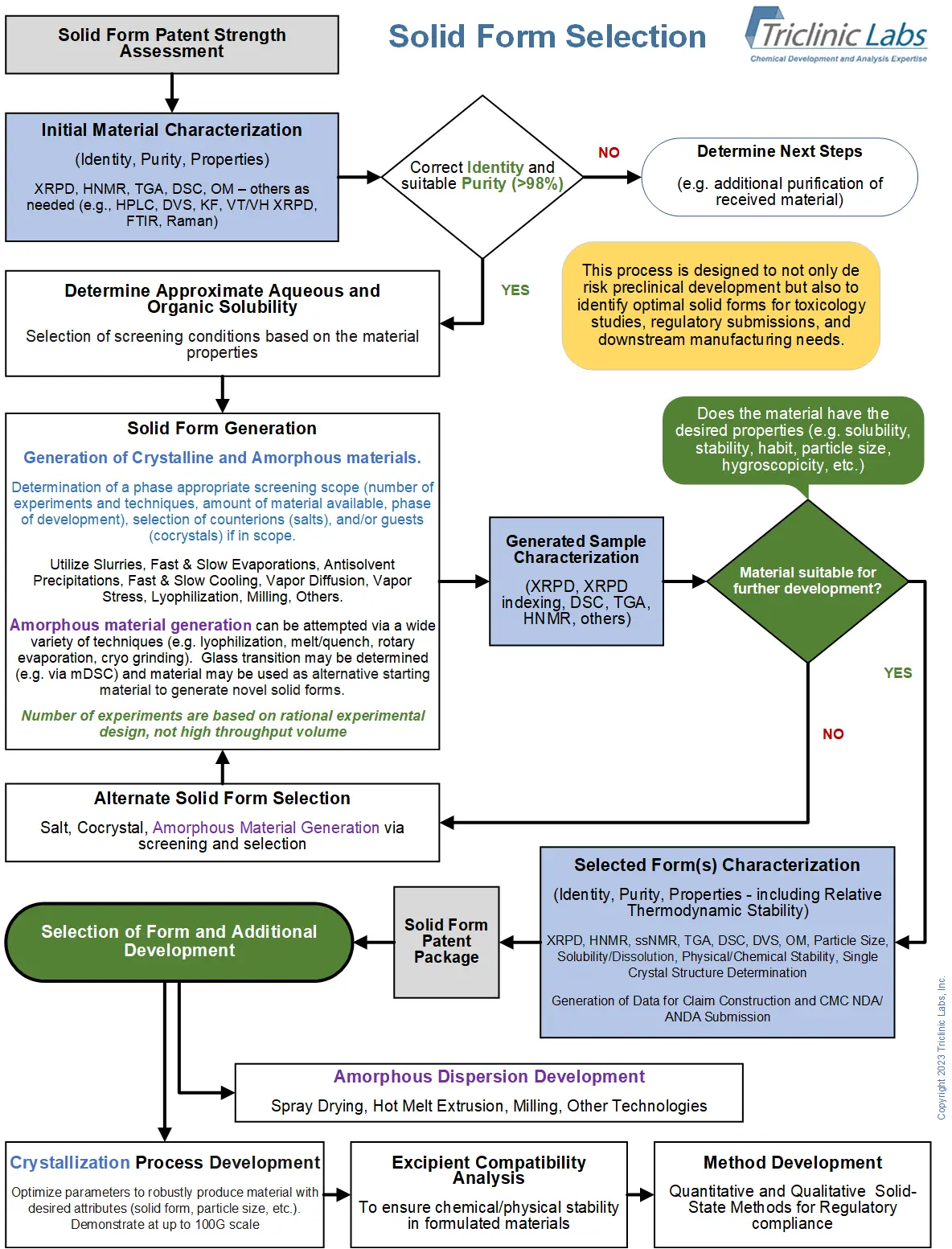
Solid form development decision tree
Use this decision tree to connect form selection, form control, formulation, process development, method development, release testing, stability, and lifecycle risk before the examples and publications section.
Salt selection must survive formulation and control risks
Salt selection can be an efficient exposure-rescue path for an ionizable API, but a salt should not be selected only because it forms quickly or dissolves faster in a first experiment. Counterion acceptability, delta pKa, route, drug loading, crystallinity, manufacturability, hygroscopicity, disproportionation, and polymorphism within the salt all affect developability.
The practical question is whether the salt can be isolated, dried, milled, formulated, stored, monitored, and reproduced without reverting toward the free acid or free base under product-relevant microenvironments.
Decision signal
What to test
Actionable output
Crystallinity
Poorly crystalline salts can be difficult to isolate, dry, mill, or release reproducibly.
Confirm by XRPD, microscopy, DSC/TGA, and lot reproducibility.
Hygroscopicity
Water uptake can drive deliquescence, hydrate formation, poor flowability, or packaging burden.
Use DVS, controlled-RH stress, water-content testing, and post-stress form ID.
Disproportionation
Local pH, water activity, and excipients can push a salt toward the neutral form.
Test excipient compatibility, wet-process stress, dissolution, and residual solids.
Salt polymorphism
The chosen salt may have multiple forms with different properties.
Run a salt-specific polymorph screen and thermodynamic ranking.
Examples and Publications.
Examples, publications, and source-backed materials
What Most Contract Research Groups Won't Tell You About Solid Form Screening
Authors: Shawn C. Comella and Aeri Park, Ph.D.
Publication date: Q3 2026
Descriptive abstract: This application note explains why experiment count is a weak measure of solid-form screening quality. It presents a risk-based, stage-appropriate framework for polymorphs, hydrates, solvates, salts, cocrystals, and amorphous forms, and connects screening design, thermodynamic ranking, orthogonal characterization, and control strategy to the development decision.
The Salt-Cocrystal Continuum: The Influence of Crystal Structure on Ionization State
Author: Scott L. Childs, G. Patrick Stahly, and Aeri Park
Publication date: 2007
Descriptive abstract: This Molecular Pharmaceutics paper explains that salts and cocrystals are distinguished by proton location, with complete proton transfer at the salt end of the spectrum and no proton transfer at the cocrystal end. It is directly relevant when a solid form sits near the salt-cocrystal boundary and classification affects analytical, regulatory, and IP strategy.
A Comprehensive Approach for Solid Form Selection in Preclinical Development and Beyond
Author: Melanie Bevill, Chris Seadeek, Nico Setiawan, Shawn Comella, Blaise Mibeck, and Steef Boerrigter
Publication date: November 2023
Descriptive abstract: This application note frames solid-form selection as a decision-driven process that compares polymorphs, salts, cocrystals, amorphous materials, hydrates, solvates, and other non-crystalline forms against developability criteria. It emphasizes crystallinity, stability, solubility, hygroscopicity, manufacturability, regulatory needs, financial risk, and intellectual property strategy rather than a high-throughput experiment count.
Diversity in Single- and Multiple-Component Crystals. The Search for and Prevalence of Polymorphs and Cocrystals
Author: G. Patrick Stahly
Publication date: May 18, 2007
Descriptive abstract: This Crystal Growth & Design review describes polymorph-screening procedures, cocrystal screening, and the observed prevalence of multiple solid forms in screening experience. It supports the central development point that alternate solid forms are common enough to require deliberate screening, characterization, and control rather than assuming the first crystalline lot is representative.
ANDAs: Pharmaceutical Solid Polymorphism: Chemistry, Manufacturing, and Controls Information
Author: U.S. Food and Drug Administration, Center for Drug Evaluation and Research
Publication date: July 2007
Descriptive abstract: This FDA guidance addresses CMC information for ANDA submissions when a drug substance can exist in polymorphic forms. It is useful context for development pages because form sameness, monitoring, control, and drug-product relevance are regulatory issues, not just analytical preferences.
Salt-cocrystal continuum and analytical classification
Salt and cocrystal classification can depend on proton position, ionization state, and crystal-structure evidence. The same API/coformer pair may sit near a salt-cocrystal continuum, making structural and spectroscopic interpretation important for regulatory and IP decisions.
Triclinic links XRPD, Raman/IR, ssNMR, thermal analysis, microscopy, solubility, and crystallization behavior to the practical question: is the selected form developable and controllable under the intended product conditions?
Other services available
Polymorph Screening and Selection
Determine whether an API can exist in multiple crystalline forms and whether form differences change solubility, dissolution, stability, manufacturing, drug-product performance, or IP.
Resolve form conversion, failed crystallizations, process sensitivity, stability drift, unexplained PK/dissolution changes, and batch-to-batch material differences.
Continue the solid-form program without returning to the service hub
Use the evidence from this service to select the next development decision. Triclinic can connect form selection, analytical characterization, crystallization and scale-up, and phase-appropriate cGMP support in one program.
Form selection
Compare polymorph, salt, cocrystal, and amorphous options against stability, solubility, manufacturability, and development-stage risk.
Why is salt screening important in pharmaceuticals?▾
Salt screening is important in pharmaceuticals because the salt form of an active pharmaceutical ingredient (API) can strongly influence whether a drug candidate becomes a successful medicine. Many APIs are converted into salts because the original molecule may have poor solubility, stability, or manufacturing properties.
When should a pharmaceutical salt be selected instead of the free acid or free base?▾
A pharmaceutical salt should be selected when ionization provides a meaningful and durable development advantage over the neutral API. Potential advantages include improved dissolution, attainable solution concentration, crystallinity, isolation, purification, handling, stability, or manufacturability. Selection should be based on the complete development profile, because a salt can also introduce hygroscopicity, hydrate or solvate formation, disproportionation, precipitation, counterion burden, or formulation incompatibility.
How can scientists identify APIs that are good candidates for salt screening?▾
Good candidates for salt screening contain sufficiently acidic or basic functional groups that can be ionized by a pharmaceutically acceptable counterion. Candidate assessment should consider measured or predicted pKa, intrinsic solubility, pH–solubility behavior, chemical stability, dose, route of administration, and the limitations of the neutral form. A favorable pKa relationship supports proton transfer, but it does not guarantee formation of a crystalline, stable, and developable salt.
Why do salt selection programs fail?▾
Salt-selection programs fail when proton transfer does not produce an isolable crystalline phase or when the resulting salt lacks a durable pharmaceutical advantage. Common causes include weak ionization, poor crystallinity, oiling, excessive hygroscopicity, hydrate or solvate formation, chemical instability, salt disproportionation, difficult processing, and precipitation of the neutral API after dissolution. Programs also fail when candidates are ranked primarily by initial solubility without evaluating solid-state stability, manufacturability, formulation compatibility, and performance in relevant media.
How can pKa predict successful salt formation?▾
The pKa relationship between an ionizable API and a proposed counterion helps estimate whether proton transfer is thermodynamically favorable. A sufficiently positive ΔpKa generally increases the likelihood of salt formation, but pKa is a solution-phase property and does not determine the final solid state by itself. Crystal packing, solvent, stoichiometry, temperature, hydration, and lattice stability can lead to a salt, cocrystal, mixed protonation state, solvate, or no isolable crystalline product.
How can salt screening be distinguished from polymorph screening?▾
Salt screening changes the chemical composition of the material by combining an ionizable API with a counterion and evaluating whether an ionic solid forms. Polymorph screening evaluates different crystalline arrangements of a defined chemical composition. A selected salt is itself a distinct chemical entity for solid-form purposes and may subsequently exhibit its own polymorphs, hydrates, solvates, amorphous phases, and processing-induced transformations.
How can salt selection improve dissolution performance?▾
A pharmaceutical salt can improve dissolution by creating a favorable microenvironmental pH, increasing the concentration gradient at the dissolving surface, and altering wettability, crystal packing, or particle properties. The advantage may be temporary if the salt converts to the neutral API, encounters a common-ion effect, or generates supersaturation followed by precipitation. Salt performance should therefore be evaluated using kinetic, phase-aware studies rather than equilibrium solubility alone.
How can salt selection influence long-term stability?▾
Salt formation can either improve or reduce long-term stability. A salt may provide a more crystalline, higher-melting, less mobile, or more readily controlled solid than the neutral API. It may also increase hygroscopicity, form hydrates, disproportionate to the free form, or create an acidic or basic microenvironment that accelerates degradation. Stability must therefore be demonstrated experimentally in the drug substance, formulation, packaging configuration, and relevant storage conditions.
What are the implications of current regulatory expectations for pharmaceutical salts?▾
Regulators expect a selected pharmaceutical salt to be adequately identified, characterized, manufactured consistently, and controlled according to its effect on drug-substance and drug-product quality and performance. The application should establish salt identity, counterion, stoichiometry, relevant solid forms, manufacturing process, impurities, stability, specifications, and analytical methods. Salt formation does not eliminate the need to understand polymorphism, hydration, solvation, particle properties, dissolution, and process-induced transformation.
Talk to a Triclinic Labs scientist about Pharmaceutical Salt Screening and Selection
Send the material history, current data package, process conditions, development objective, and timeline. Triclinic will route the request to the right solid-form scientist. For a connected program from candidate nomination through IND, explore the candidate-to-IND solid-form development pathway.