
Unknown Contaminant Identification
Identify isolated particles, residues, coatings, or packaging materials found during a suspect-product comparison.


Counterfeit and falsified pharmaceutical investigations usually involve two linked questions: whether the suspect article is consistent with an authentic reference, and which specific physical or chemical differences explain that conclusion. Triclinic approaches these projects as multidisciplinary comparisons of the dosage form, packaging, label, adhesive, seal, ink, container, cap, and any available authentic lots.
The strongest studies preserve the article whenever possible, document the chain of custody, and start with non-destructive or minimally destructive methods before progressing to destructive testing. Optical microscopy, calibrated measurements, Raman microscopy, FTIR microspectroscopy, SEM/EDX, and spectral-library searching can be combined with direct authentic-versus-suspect comparisons so that conclusions do not rest on one weak signal.
Triclinic's counterfeit-analysis work is built around direct comparison of suspect articles against authentic reference materials. The examples below show how visual inspection, optical microscopy, IR spectroscopy, Raman spectroscopy, and packaging or seal comparisons can be combined to separate true counterfeiting from legitimate production variation.
Goal: Determine whether a submitted final dosage container was authentic or potentially counterfeit. The investigation used a multidisciplinary workflow that included visual inspection, optical microscopy, infrared spectroscopy, and Raman spectroscopy.
The label, container, and induction seal were evaluated as separate evidence streams. Differences between the suspect and authentic articles were compared against authentic-material basis sets so that observed packaging differences were not over-interpreted as counterfeiting without supporting chemical evidence.
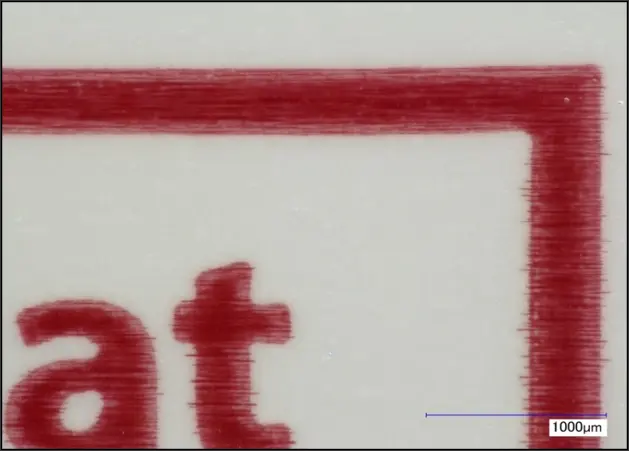
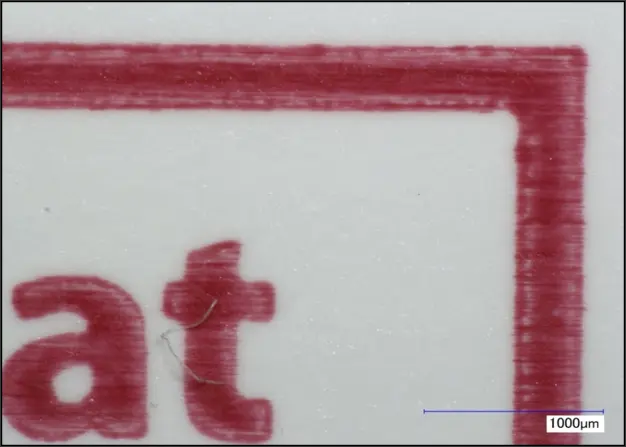
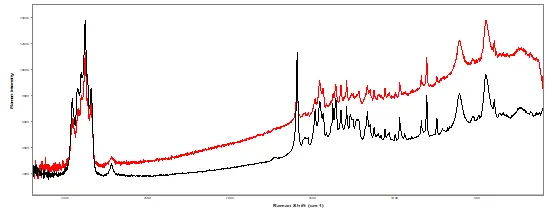
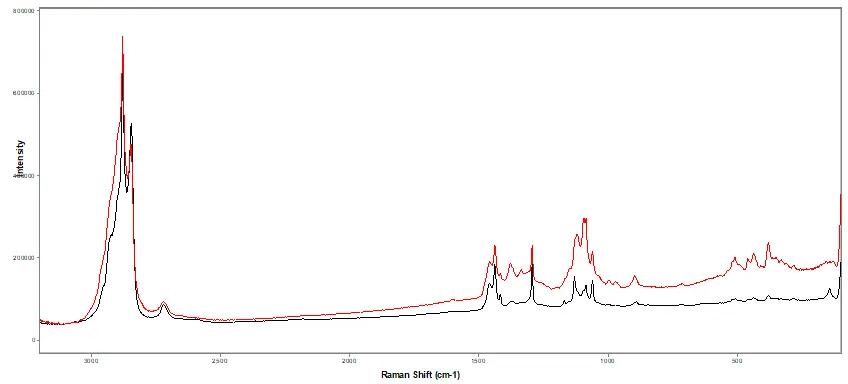
Conclusion: The submitted materials were authentic. The observed differences were attributed to production-run variation in packaging, including use of a different printing company, rather than counterfeit substitution.
Goal: Identify whether suspect tablets from an open final-dosage container were authentic or counterfeit. Three tablets appeared suspect and were compared against authentic reference product using physical inspection and chemical identification.
Visual and dimensional differences supported the counterfeit hypothesis before spectroscopy was performed. The suspect tablets differed in color, embossing, and physical dimensions from authentic material. Raman spectroscopy was then used to compare the suspect tablet to reference spectra and to identify key chemical components.
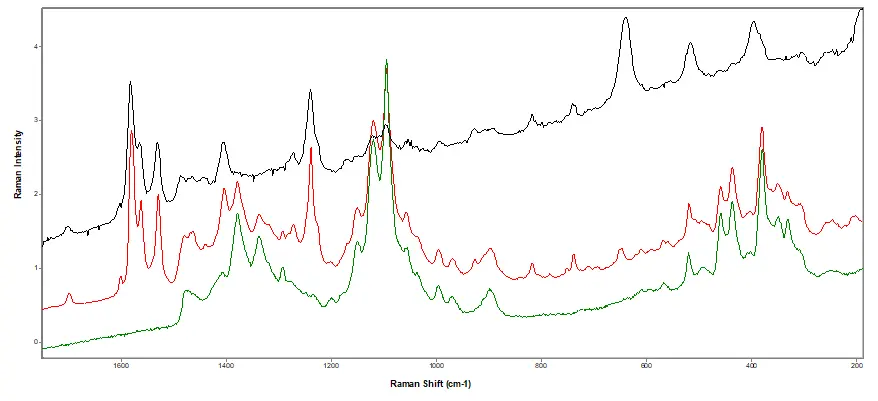
Conclusion: The suspect tablets were counterfeit. The tablets were identified as containing sildenafil citrate with microcrystalline cellulose and titanium dioxide, and the visual inspection results were inconsistent with the authentic reference product.
| Technique or platform | Information produced | Why it matters |
|---|---|---|
| Optical and digital microscopy | Visual morphology, dimensions, surface features, color, layering, and sample-selection context. | Documents the evidence before destructive testing and helps select specific particles or regions for analysis. |
| Raman microscopy and chemical mapping | Molecular fingerprints and spatial distribution of many APIs, excipients, pigments, polymers, and crystalline components. | Useful for suspect-versus-authentic comparisons, coating/core analysis, layered systems, and localized unknowns. |
| FTIR and IR microspectroscopy | Polymer, organic, excipient, adhesive, fiber, film, and residue identification. | Often strong for particles, fibers, packaging materials, cap liners, label adhesives, and contact-material comparisons. |
| SEM/EDX | High-resolution morphology plus elemental composition and elemental maps. | Critical for inorganic particles, fillers, talc-related signals, metals, corrosion, pigments, and source comparisons. |
| LC/MS, GC/MS, chromatography, NMR, or ICP-MS | Targeted or investigative molecular, volatile/semi-volatile, structural, or trace-element information. | Added when direct microanalysis is not enough or when confirmation, quantitation, or structural assignment is required. |
Identify isolated particles, residues, coatings, or packaging materials found during a suspect-product comparison.
Compare elemental profiles, pigments, fillers, metals, and localized inorganic components in authentic and suspect materials.
Determine whether an observed difference is consistent with formulation, manufacturing, packaging, handling, or environmental sources.
Identify unexpected chromatographic peaks or chemical components that distinguish a suspect product from an authentic reference.
The comparison can include dosage-form composition, active and excipient signals, particle and surface features, packaging, seals, labels, printing, adhesives, and other available reference evidence. The scope is based on the suspected difference and the decision the comparison must support.
Often. Orthogonal chemical and physical evidence can show differences in ingredients, relative component distribution, crystal form, elemental profile, morphology, coatings, or packaging. The report should distinguish observed differences from conclusions about their cause.
Often, if they can be documented and isolated without introducing contamination. Microscopy-guided Raman spectroscopy, Fourier-transform infrared spectroscopy, or scanning electron microscopy with energy-dispersive X-ray spectroscopy can evaluate selected particles or regions independently from the bulk product.
Authentic product from a documented source, retained lots, packaging components, labels, closures, inserts, raw materials, and known manufacturing references make the comparison stronger. Chain of custody and photographs should be preserved when the findings may support legal or regulatory action.

Share the suspect and authentic products, packaging components, photographs, chain-of-custody information, observed differences, available reference materials, and the quality, regulatory, or legal decision the comparison must support.