What is this?
cGMP NMR is regulated nuclear magnetic resonance testing used for liquid-state identity, qNMR purity, reference-material verification, compendial methods, method development, validation, release testing, and transfer.


When structural certainty matters, Nuclear Magnetic Resonance (NMR) often provides the most definitive analytical evidence available. Whether confirming molecular identity, characterizing impurities, performing quantitative NMR, or supporting investigations, Triclinic Labs generates scientifically defensible NMR data using qualified instrumentation, validated methods, and complete cGMP documentation suitable for regulated decision-making.
Our scientists focus on interpretation and problem-solving, not simply spectrum generation.
The content of this page was scientifically reviewed by Byungsu Kwon, Ph.D., Director of NMR Services at Triclinic Labs · Updated 8/1/2026


cGMP NMR is regulated nuclear magnetic resonance testing used for liquid-state identity, qNMR purity, reference-material verification, compendial methods, method development, validation, release testing, and transfer.
Use it when molecular identity, assay, purity, reference standard qualification, or formulation/deformulation questions require a selective spectral method that can be validated or verified for the intended matrix.
NMR requires suitable solubility, adequate sensitivity, appropriate nuclei, reference standards where quantitative, and well-controlled integration/baseline methods. Solid-state NMR may be non-GMP or R&D depending on scope and instrument qualification.
NMR sample needs depend on concentration, nucleus, experiment type, probe, sensitivity, replicate needs, and whether quantitative work or validation is required. Exact needs should be scoped before sample shipment.
Complementary techniques include high-performance liquid chromatography (HPLC), ultra-performance liquid chromatography (UPLC), gas chromatography (GC), liquid chromatography-mass spectrometry (LC-MS), high-resolution mass spectrometry (HRMS), Fourier-transform infrared (FTIR) and Raman spectroscopy, X-ray powder diffraction (XRPD), and elemental analysis. They add separation, sensitivity, solid-form, or elemental evidence to NMR identity, assay, impurity, and structural results.
FDA cares that the method is scientifically justified, specific for the intended attribute in the real matrix, controlled under the quality system, validated or verified where appropriate, data-integrity compliant, and lifecycle managed.
Common mistakes include using exploratory data as release evidence, validating the wrong matrix, ignoring sample preparation, under-documenting controls, relying on one technique when orthogonal evidence is needed, or failing to define the decision before testing.
Triclinic uses cGMP NMR when identity, assay, purity, residual solvent, counterion, mixture composition, or structural confirmation must be supported with controlled acquisition, processing, review, and reporting. Real-world applications include qNMR assay support, reference-standard characterization, impurity or degradant confirmation, release and stability testing, and investigations that require molecular evidence suitable for a regulated quality record.
Exploratory data can help choose a method, but release or filing-support data require controlled execution. The method must be suitable for the matrix, the quality attribute must be defined, reference standards and controls must be appropriate, and the report or CoA must say only what the data support.
| cGMP concern | Why it matters | Practical control |
|---|---|---|
| Method status | Exploratory, verified compendial, validated custom, and transferred methods have different evidence requirements. | Define status before testing and document any development, verification, validation, or transfer work. |
| Sample matrix | Specificity can fail in real drug product, excipient, talc, low-dose, or complex solid mixtures. | Use representative material, placebo/matrix controls, spike studies, or orthogonal methods where needed. |
| Data integrity | Release or stability results must survive QA review, audit, and regulatory scrutiny. | Use controlled records, system suitability, analyst review, deviations/OOS process, and traceable calculations. |
The table below lists the specific platforms, brands, models, software, detectors, and capability notes relevant to this cGMP service area.
| Instrument or platform | Brand, model, software, or detector | Additional capabilities and use |
|---|---|---|
| 400 MHz NMR platform | Bruker Avance NEO 400 MHz NMR | cGMP and non-cGMP liquid-state NMR and non-GMP solid-state NMR for structure confirmation, qNMR, impurity support, and reference-standard characterization. |
| Multinuclear probes | Broadband probes supporting 1H, 13C, 31P, 19F, 15N, and other nuclei | Multinuclear structural and quantitative experiments for drug substances, drug products, impurities, salts, excipients, and formulated systems. |
| NMR software | Bruker TopSpin 4.1.4 plus additional spectral-analysis software packages | Acquisition, processing, integration, spectral comparison, qNMR calculations, and structural interpretation. |
| Variable-temperature liquids NMR | Variable-temperature NMR capability, 280-350 K (7°C-77°C) | Temperature-dependent solution-state behavior, exchange/process studies, and method-specific solvent/formulation investigations. |
| Higher-field NMR access | Higher-field support for advanced studies (for example, 800 MHz equipped with cryoprobes) | Higher-field resolution/sensitivity when structural complexity, low concentration, or overlap requires additional resolving power. |
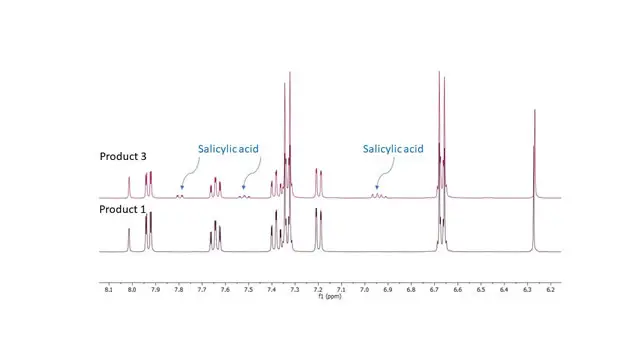
This mini case study illustrates how qNMR can support a regulated potency or assay question when the components are soluble, peaks are resolved, internal standard selection is appropriate, and integration is controlled. Three generic Excedrin-type tablet products were dissolved in DMSO-d6 with maleic acid as an internal standard, allowing labeled content to be compared with measured content while also flagging salicylic-acid evidence in one product.
| Components | Dosage Label Claim (mg/tablet) | Actual Dosage Product 1 | Actual Dosage Product 2 | Actual Dosage Product 3 |
|---|---|---|---|---|
| Acetaminophen | 250 | 98% | 83% | 110% |
| Aspirin | 250 | 101% | 98% | 66% |
| Caffeine | 65 | 115% | 115% | 107% |
| Comments | Contains salicylic acid (see figure below) |
The figure below provides the spectral context for the table. It shows the salicylic-acid signal that supports the Product 3 comment and illustrates why qNMR interpretation must connect sample preparation, peak selection, specificity, and integration controls to the intended cGMP use.
These examples cite Triclinic source documents, regulatory guidance, or literature relevant to our cGMP NMR service.
Author: Maria Victoria Silva Elipe
Publication date: 2024
Abstract: This RSC chapter describes NMR applications in drug-substance and drug-product development, including identity, structure, purity, formulation questions, and regulatory-support contexts.
Author: International Council for Harmonisation / FDA
Publication date: 2024
Abstract: These harmonized guidances describe validation and development principles for analytical procedures used to assess drug-substance and drug-product quality. They anchor expectations for specificity, accuracy, precision, range, robustness, lifecycle management, and fit-for-purpose method evidence in cGMP work.
Use cGMP XRPD for solid-form identification, polymorph or phase quantitation, crystallinity, method validation, release, and stability support.
View serviceDevelop, validate, verify, and transfer wet or dry particle-size methods for release specifications and quality decisions.
View serviceUse cGMP DSC and TGA to evaluate melting, desolvation, dehydration, glass transitions, degradation, and thermal material control.
View serviceUse cGMP Raman and FTIR for raw-material ID, solid-form differentiation, mapping, contaminant ID, and validated spectroscopic methods.
View serviceUse cGMP microscopy and particle morphology evidence for identification, particle shape, foreign-material work, and regulated investigations.
View serviceUse verified or validated methods to support batch disposition, CoA issuance, stability testing, and regulatory documentation.
View serviceRun the work under cGMP when the result will support release, stability, regulatory documentation, method validation or transfer, CoA issuance, or a quality investigation rather than exploratory screening only.
Material requirements depend on method, matrix, replicate design, standards, destructive testing, retain needs, and whether method development, validation, transfer, or release testing is required. Confirm exact amounts before shipment.
Yes. The project should be scoped from the quality attribute, sample matrix, method status, and regulatory decision before selecting a technique or validation plan.
Defensible cGMP results require appropriate method status, sample traceability, reference standards, controls, system suitability, analyst training, data review, and clear reporting of limitations.
Yes. Triclinic develops, validates, and transfers NMR methods when structural identity, impurity confirmation, solid-state form, solvent or residual-content questions, or quantitative NMR measurements need controlled execution. Method work can address nuclei, pulse sequence, acquisition parameters, reference materials, sample preparation, integration or chemometric approach, specificity, precision, robustness, and transfer requirements appropriate to the intended cGMP use.
Yes, when the analyte is suitable, representative resonances are resolved, the reference standard is appropriate, and method parameters, system suitability, integration, relaxation, sample preparation, validation, and data review are controlled.

Send the sample type, intended use of the data, method or monograph if available, specification, matrix, timeline, and whether the work is exploratory, cGMP, validation, transfer, stability, release, or investigation support.