Use differential scanning calorimetry (DSC) and thermogravimetric analysis (TGA) for melting, desolvation, dehydration, glass transitions, polymorph conversion, degradation, and material control.
Interpret thermal events in the context of product performance
Melting, glass transitions, solvent or water loss, degradation, and polymorphic transformations can determine formulation performance, manufacturing robustness, and long-term stability. Triclinic Labs performs differential scanning calorimetry (DSC) and thermogravimetric analysis (TGA) using qualified instrumentation, validated or verified methods, and complete cGMP documentation to support development, release testing, stability programs, investigations, and regulatory filings.
Our scientists interpret thermal events alongside sample history and complementary solid-state evidence rather than reporting transition temperatures without context.
The content of this page has been scientifically reviewed by Nico Setiawan, Ph.D., Analytical Director at Triclinic Labs · Updated 8/1/2026
Overview of cGMP Thermal Analysis by TGA and DSC Services
What is this?
Thermogravimetric analysis (TGA) measures mass change as a function of temperature or time and is used to evaluate water or solvent loss, decomposition, oxidative behavior, and residue. Differential scanning calorimetry (DSC) measures heat flow and is used to evaluate melting, crystallization, glass transition, polymorphic transitions, heat capacity, and other thermal events. Together, the techniques provide complementary evidence about material composition, physical state, and thermal stability.
When is it used?
Use it when specifications or investigations require thermal identity, moisture/solvent-related behavior, polymorph screening support, amorphous content, stability interpretation, or raw-material qualification.
What are limitations?
Thermal events are not chemically or structurally specific. Events may overlap, heating can create artifacts, and a mass-loss event does not by itself establish whether the evolved material is water, solvent, or a degradation product. Karl Fischer titration, evolved-gas Fourier-transform infrared (FTIR) spectroscopy or mass spectrometry (MS), X-ray powder diffraction (XRPD), Raman spectroscopy, or other orthogonal methods may be required for confirmation.
What sample amounts are needed?
Many DSC/TGA runs use small milligram-scale samples, but cGMP method development and validation need replicate material and representative lots.
Complementary Techniques
Complementary techniques include Karl Fischer titration, dynamic vapor sorption (DVS), X-ray powder diffraction (XRPD), Raman and Fourier-transform infrared (FTIR) spectroscopy, microscopy, solid-state nuclear magnetic resonance (NMR), chromatography, and evolved-gas analysis. They identify the water, solvent, phase, or chemical change responsible for a thermal event.
What does FDA care about?
FDA cares that the method is scientifically justified, specific for the intended attribute in the real matrix, controlled under the quality system, validated or verified where appropriate, data-integrity compliant, and lifecycle managed.
What are common mistakes?
Common mistakes include using exploratory data as release evidence, validating the wrong matrix, ignoring sample preparation, under-documenting controls, relying on one technique when orthogonal evidence is needed, or failing to define the decision before testing.
What is Triclinic's experience with this technique
Triclinic uses cGMP thermal analysis when DSC or TGA results must support regulated decisions about solid form, hydration, solvation, residual volatile content, amorphous/crystalline balance, stability, or material comparability. Real-world applications include release or stability methods, validated or verified thermal procedures, investigation support, and controlled reporting that links thermal events to quality-relevant material attributes.
What changes when the work is cGMP?
Exploratory data can help choose a method, but release or filing-support data require controlled execution. The method must be suitable for the matrix, the quality attribute must be defined, reference standards and controls must be appropriate, and the report or CoA must say only what the data support.
cGMP concern
Why it matters
Practical control
Method status
Exploratory, verified compendial, validated custom, and transferred methods have different evidence requirements.
Define status before testing and document any development, verification, validation, or transfer work.
Sample matrix
Specificity can fail in real drug product, excipient, talc, low-dose, or complex solid mixtures.
Use representative material, placebo/matrix controls, spike studies, or orthogonal methods where needed.
Data integrity
Release or stability results must survive QA review, audit, and regulatory scrutiny.
Use controlled records, system suitability, analyst review, deviations/OOS process, and traceable calculations.
Specific instruments and capabilities for cGMP Thermal Analysis by TGA and DSC
The table below lists the specific platforms, brands, models, software, detectors, and capability notes relevant to this cGMP service area.
Instrument or platform
Brand, model, software, or detector
Additional capabilities and use
Thermogravimetric analysis
TA Instruments Q50 and TA Discovery 5500 TGA systems
Mass-loss, moisture/volatile content, decomposition, oxidative stability, and residue/composition analysis.
TGA-IR evolved-gas analysis
TA TGA with Thermo iS50 FT-IR interface; DTGS detector; gas cell to 250 °C; transfer line to 225 °C; nitrogen or helium purge
Evolved-gas identification, volatile/decomposition-product interpretation, and coupling of weight-loss events to IR spectra.
TGA software
Thermal Advantage Release 5.5.24; TRIOS v.5.7.2.101 for Discovery 5500 workflows
Thermal-method acquisition, processing, reporting, and data review.
Differential scanning calorimetry
TA Instruments Q2000 and Discovery DSC 2500 systems
Melting, crystallization, glass transition, heat capacity, compatibility, and transition-enthalpy measurements.
Modulated DSC capability
TA Discovery DSC configuration with modulated DSC support
Separation of overlapping reversible/non-reversible events and improved amorphous-content / glass-transition interpretation.
DSC software
Thermal Advantage Software v.5.5.24
DSC acquisition and thermal-event analysis for cGMP and non-GMP workflows.
Kofler Hot-Stage Microscopy and Thermal Event Interpretation
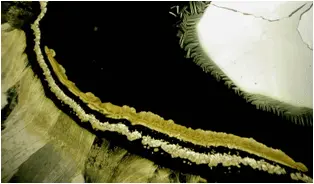
This example shows why visual thermal evidence can be useful when DSC or TGA events overlap or require interpretation. TGA, TG-IR, DSC, microcalorimetry, and hot-stage microscopy can support moisture/volatile loss, degradation, glass transition, crystallization, melting, oxidative stability, and phase-transition questions. For cGMP methods, event assignment must be tied to the intended quality attribute and supported by orthogonal methods where form identity matters.
Hot-stage microscopy and Kofler cocrystal formation example. The image illustrates how melting, recrystallization, or cocrystal formation can be observed directly during heating. In regulated thermal work, visual evidence can help explain DSC/TGA events but should be paired with XRPD, Raman/FTIR, or another form-confirming technique before assigning a specific solid form. Source: Triclinic Labs thermal-analysis material.
Technical Resources and Publications
These examples cite Triclinic source documents, regulatory guidances, or literature relevant to this cGMP service. Download buttons are positioned at the bottom-left of each example.
Amorphous Content Quantitation via mDSC
Author: Triclinic Labs
Publication date: 2025
Abstract: This application note uses modulated DSC to quantify amorphous content in crystalline API by heat-capacity change at the glass transition, supporting thermal-method use for cGMP-capable material control strategies.
ICH Q2(R2) Validation of Analytical Procedures and ICH Q14 Analytical Procedure Development
Author: International Council for Harmonisation / FDA
Publication date: 2024
Abstract: These harmonized guidances describe validation and development principles for analytical procedures used to assess drug-substance and drug-product quality. They anchor expectations for specificity, accuracy, precision, range, robustness, lifecycle management, and fit-for-purpose method evidence in cGMP work.
DSC should be selected when the primary question concerns heat-flow events such as melting, glass transition, crystallization, enthalpy relaxation, or a solid-solid transformation. TGA should be selected when the question concerns mass change, including water or solvent loss, volatilization, oxidation, sublimation, or decomposition. Because many pharmaceutical events involve both heat flow and mass loss, DSC and TGA are frequently complementary.
How can a DSC thermogram be interpreted?▾
Evaluate the direction, onset, peak temperature, breadth, enthalpy, reversibility, and sequence of events in relation to composition, solid form, thermal history, pan configuration, atmosphere, and heating rate. Endotherms may indicate melting, dehydration, desolvation, or solid-state transitions; exotherms may indicate crystallization, conversion, oxidation, reaction, or degradation. Assignments may require TGA, XRPD, microscopy, spectroscopy, or chemical analysis.
Can DSC independently identify pharmaceutical polymorphs?▾
No. DSC can show different thermal behaviors, but it cannot independently establish polymorphic identity because melting, recrystallization, desolvation, decomposition, impurities, particle size, and experimental conditions can produce similar or overlapping events. XRPD is generally the primary method for distinguishing crystalline phases, while DSC provides complementary information about transition temperatures, melting behavior, enthalpy, and kinetic relationships.
How can thermal degradation be distinguished from melting?▾
Determine whether the event involves chemical change, mass loss, gas evolution, discoloration, irreversible residue, or altered composition. Melting normally represents loss of crystalline order without changing molecular identity, whereas degradation produces new chemical species. DSC alone may not distinguish them. TGA, simultaneous DSC-TGA, hot-stage microscopy, evolved-gas analysis, chromatography, spectroscopy, and heated-residue analysis may be required.
Why do multiple thermal events appear in DSC data?▾
Pharmaceutical materials can undergo several sequential or overlapping processes during heating, including glass transition, enthalpy relaxation, dehydration, desolvation, solid-solid conversion, crystallization, eutectic melting, melting, oxidation, reaction, and decomposition. Multiple events do not automatically prove multiple polymorphs or components. Interpretation requires correlation with TGA, XRPD, microscopy, spectroscopy, chemical analysis, pan conditions, heating rate, and sample history.
When should modulated DSC be used?▾
Use modulated DSC when conventional DSC cannot adequately separate overlapping events or when a weak glass transition must be distinguished from enthalpy relaxation, crystallization, evaporation, curing, or other kinetic processes. It is especially useful for amorphous materials, polymers, solid dispersions, partially crystalline samples, and complex formulations. TGA, XRPD, microscopy, or chemical analysis may still be needed when phase identity or degradation is uncertain.
How can TGA identify volatile components and solvates?▾
TGA detects and quantifies volatile components by measuring percentage mass loss as temperature or time increases. Stepwise losses may support the presence of moisture, hydrate water, residual or channel solvent, stoichiometric solvates, volatile excipients, subliming material, or degradation products. TGA does not identify the volatile species or prove lattice incorporation, so confirmation may require Karl Fischer titration, gas chromatography, evolved-gas analysis, XRPD, DVS, spectroscopy, or controlled-humidity studies.
How can thermal analysis support excipient compatibility studies?▾
DSC and TGA can screen API-excipient mixtures for changes in melting, glass transition, crystallization, volatile loss, reaction enthalpy, and degradation behavior. Peak shifts, broadening, or disappearance do not independently prove incompatibility. Results must be compared with the individual components and interpreted in light of mixture composition, preparation, pan conditions, and chemical stability data. HPLC, XRPD, FTIR, Raman, microscopy, moisture analysis, or stressed-storage studies may be needed for confirmation.
Discuss cGMP testing requirements
Send the sample type, intended use of the data, method or monograph if available, specification, matrix, timeline, and whether the work is exploratory, cGMP, validation, transfer, stability, release, or investigation support.