
cGMP Method Transfer
Move an established procedure to a receiving laboratory after its method package and readiness gaps are understood.

Analytical method development services should be phase-appropriate, scientifically defensible, and practical for the laboratory that will execute the procedure. Poor analytical methods rarely fail during development—they fail during transfer, validation, routine QC testing, or FDA inspection. A method that appears acceptable in the laboratory can become a source of OOS investigations, repeat testing, manufacturing delays, and regulatory questions if robustness and controls are not engineered from the beginning. Triclinic Labs develops and troubleshoots cGMP analytical methods for manufacturing laboratories and long-term lifecycle performance. Using current ICH expectations, risk-based experimental design, and decades of pharmaceutical experience, we build methods that withstand validation, technology transfer, commercial manufacturing, and regulatory scrutiny rather than simply generating acceptable validation statistics.
We develop methods with the end user in mind—QC analysts, manufacturing, and regulators—not just the development laboratory.
Content scientifically reviewed by Andy Gilkison, Ph.D., Senior Director, Method Development at Triclinic Labs · Updated 9/1/2026
Work begins with the analytical target profile or intended-use statement: what attribute must be measured, in which material and matrix, over what range, with what decision limit, and under which quality status. Development then addresses the failure modes most likely to undermine routine use, including selectivity, sample-preparation variability, matrix interference, instability, form conversion, inadequate sensitivity, calibration design, and unrealistic system suitability.
Validation demonstrates that a noncompendial procedure performs suitably for its intended use. The selected characteristics may include specificity, accuracy, precision, intermediate precision, linearity, range, detection limit, quantitation limit, robustness, system suitability, and sample or solution stability. Verification is narrower: it confirms that a compendial procedure performs suitably in the proposed laboratory and matrix without implying that the full procedure has been revalidated.
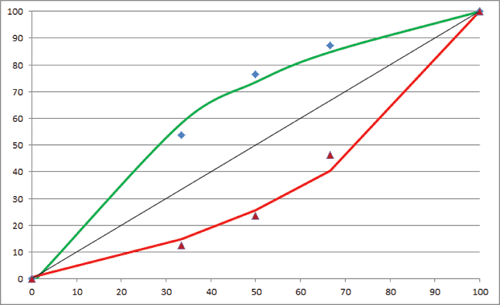
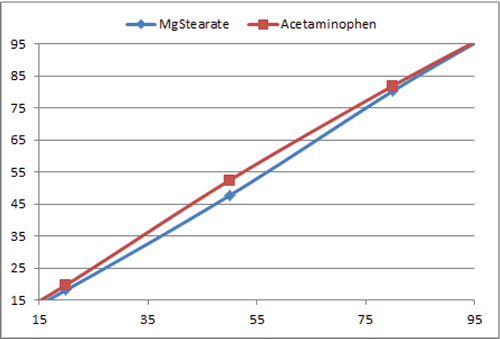
For solid-state methods, the design may also need to control particle size, packing density, preferred orientation, form conversion, excipient interference, reference standards, instrument geometry, and the choice between univariate and multivariate calibration.
Regulated method work should be scoped to the intended use of the procedure, the sample matrix, the decision the data must support, and the quality-system status of the work. For cGMP work, laboratory controls, specifications, sampling, testing, release decisions, and laboratory records must be planned so that the resulting data package can be reviewed, repeated, and defended.
Move an established procedure to a receiving laboratory after its method package and readiness gaps are understood.
Execute a validated, verified, or transferred procedure against defined specifications under controlled cGMP documentation.
Select an appropriate platform for the material, matrix, sensitivity, specificity, and evidence requirements.
Connect method work to regulated spectroscopy, diffraction, chromatography, particle, thermal, morphology, and NMR services.
Validation demonstrates that a noncompendial procedure is fit for its intended use. Verification confirms that a compendial procedure can achieve suitable performance in the proposed laboratory and sample matrix. The required verification work depends on the procedure, matrix, risk, and available evidence.
Depending on the intended use, validation may evaluate specificity or selectivity, accuracy, repeatability, intermediate precision, linearity, range, detection limit, quantitation limit, robustness, system suitability, and sample or solution stability.
Yes. Solid-state validation may require controls for form specificity, matrix effects, sample preparation, particle properties, standards, instrument configuration, calibration design, and data processing.
Often, but the procedure must first be assessed for intended use, matrix suitability, controls, system suitability, acceptance criteria, reference materials, record requirements, robustness, and the validation or verification evidence needed for controlled use.
Acceptance criteria should follow from intended use, product and process risk, specification needs, prior method performance, matrix behavior, reference materials, and applicable regulatory or compendial expectations.
Deliverables may include an analytical target profile, development report, controlled procedure, validation or verification protocol, execution data, deviations, final report, method limitations, and recommendations for transfer or routine use.

Send the method, matrix, intended use, specification, sample type, quality status, and whether the work supports development, validation, transfer, release, stability, or investigation support.
 Common questions