
Paragraph IV ANDA Expert Support
Scientific work plans, comparative testing, and expert-witness support for ANDA and Hatch-Waxman technical issues.

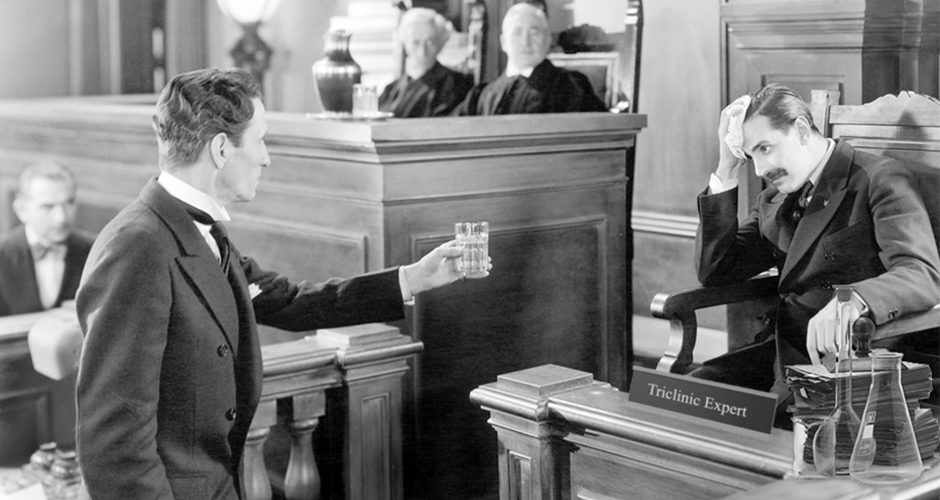
Patent and commercial disputes can involve technical issues that are difficult to explain clearly: solid forms, analytical specificity, prior-art reproducibility, impurities, formulation behavior, process changes, particle properties, moisture effects, or laboratory-method limitations.
Triclinic scientists may serve as fact witnesses or expert witnesses, depending on the engagement. Support may include data review, experimental design, material characterization, technical memoranda, figures, declaration support, expert-report support, and preparation for testimony where appropriate to the engagement.
The role and scope should be defined at the start. Some matters need laboratory testing; others need technical review, explanation of prior data, or support for a retained expert.
Triclinic begins by defining the scientist's role: fact witness, consulting expert, testifying expert, laboratory investigator, or support for another retained expert. A fact witness testifies about work performed, observations made, records created, or other firsthand knowledge. An expert witness may analyze evidence and offer opinions within the scientist's qualified area of expertise. The defined role determines the records, communication structure, laboratory workflow, and deliverables.
Technical work is then scoped around either the facts to be documented or the expert opinions to be developed. If new experiments are needed, methods are selected for specificity, defensibility, and relevance to the question rather than convenience. If the work is a data review, the focus is on whether the data actually support the proposed technical interpretation.
The final materials are designed for scientific clarity. They identify what was reviewed or tested, what the data show, what limitations apply, and what additional work may be needed.
Expert-witness support is strongest when it is grounded in specific technical questions and a clear record. Triclinic can support matters where chemistry, materials characterization, solid-state behavior, or analytical-method performance affects the dispute.
The work may involve review of data produced by others, generation of new data, or both.
Patent-term restoration, regulatory exclusivity, secondary patent portfolios, and Paragraph IV timing can be commercially important, but the scientific witness still needs to stay anchored to the technical record. DrugPatentWatch’s lifecycle discussion is a useful reminder that these disputes are often driven by timing and market consequences; expert-witness support must still explain the underlying facts without converting them into legal conclusions.
Triclinic can help counsel and retained experts organize those facts: what material was tested, what method was used, what the method can and cannot distinguish, what uncertainty remains, and how the analytical evidence relates to the asserted solid-form, formulation, process, or prior-art issue.
Review DrugPatentWatch’s overview of pharmaceutical patent longevity
Scientific work plans, comparative testing, and expert-witness support for ANDA and Hatch-Waxman technical issues.
Controlled execution and characterization of prior-art examples where the resulting material matters.
Assessment of whether solid-form claims are supported by reproducible, distinguishable analytical evidence.
Screening, selection, characterization, and control of polymorphs, salts, cocrystals, hydrates, solvates, and amorphous materials.
Crystal, molecular, impurity, and structure-determination support when structural proof is central to the question.
Yes. Subject to conflict review, availability, qualifications, and engagement terms, a Triclinic scientist may serve as an expert witness or fact witness. The role, scope, reporting requirements, document-retention obligations, communications, and testimony expectations should be defined before work begins.
Yes. Triclinic can generate data, review methods, prepare figures, reproduce procedures, and help organize technical evidence for a retained expert.
Yes, if testing is needed and the materials, timeline, documentation requirements, and quality status fit the project scope.
Matters involving solid forms, analytical methods, prior art, impurities, contaminants, formulation behavior, material properties, reproducibility, or laboratory records may be a fit.
No. Triclinic provides scientific testing, technical analysis, and expert-witness support. Legal strategy and legal conclusions remain with counsel.
Define whether the scientist is serving as a fact witness, consulting expert, testifying expert, laboratory investigator, or support for another retained expert. Scope, privilege, reporting, document retention, communications, and testimony expectations should be agreed before work begins.

Share the technical issue, role needed, key deadlines, available records, sample status, and whether new testing may be required. Triclinic can help determine the scientific scope and the right support model.

 Common questions