Pharmaceutical Cocrystal Screening and Development
Use cocrystals to tune API properties, support formulation strategy, and build solid-form lifecycle options.
Use cocrystals when solid-form property improvement requires a multicomponent crystal
Cocrystals, sometimes written co-crystals, are multicomponent crystalline solids containing an active pharmaceutical ingredient (API), or an API salt, and a coformer in a defined stoichiometric ratio. Unlike salts, which involve proton transfer and ionic species, cocrystals are stabilized primarily by nonionic intermolecular interactions such as hydrogen bonding. Screening can identify forms that improve solubility, dissolution, hygroscopicity, polymorphic complexity, physical or chemical stability, purity, developability, and intellectual-property position.
The content of this page has been scientifically reviewed by Aeri Park, Ph.D., COO at Triclinic Labs · Updated 8/1/2026
Content also reviewed by Melanie Bevill, Group Leader at Triclinic Labs · Updated 8/1/2026
Why cocrystals are a practical development option
A cocrystal screen is appropriate when an API is non-ionizable, salt formation does not provide a suitable form, a specific solid-state property requires improvement, or the program needs additional solid-form intellectual-property options. The practical value is not simply finding a new diffraction pattern; it is identifying a candidate that provides a measurable advantage and can be prepared reproducibly.
Triclinic evaluates leading candidates against the client’s target product profile and develops solution-based crystallization conditions that can support downstream scale-up. Candidate evaluation can include physical and chemical stability, hygroscopicity, solubility, dissolution, polymorphic complexity, solid-phase purity, and preparation reproducibility.
Solubility-guided cocrystal screening and solution-based development
Triclinic uses an extensive coformer list and a solubility-guided approach rather than relying on formulaic screening. The solubility and functional-group compatibility of the API and coformer help identify promising experimental conditions. Screening may use solvent-drop grinding, solution-based precipitation, slurry experiments, and thermal methods.
Initial hits are identified by X-ray powder diffraction (XRPD) and characterized as appropriate to establish composition, stoichiometry, solid-phase purity, physical or chemical stability, solubility, hygroscopicity, and polymorphic complexity. Reproducible solution-based conditions can then be developed for leading candidates to support downstream scale-up.
Cocrystal formulation: spring and parachute logic
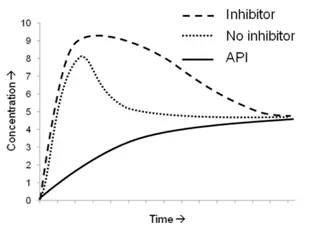
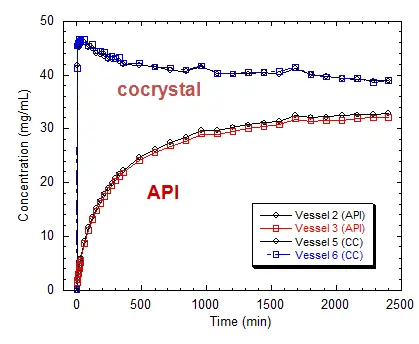
Cocrystal formulation is often a supersaturation problem. The cocrystal can set the spring by generating a higher API concentration, but formulation must open the parachute by delaying crystallization long enough for absorption.
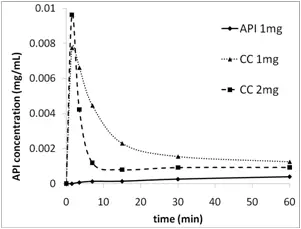
Higher cocrystal loading does not automatically improve exposure. Once supersaturation is too high, API crystallization can accelerate and reduce the benefit. Therefore cocrystal selection should include dissolution, crystallization-inhibition, and formulation stress experiments.
How Triclinic scopes cocrystal screening and evaluation
A cocrystal program should not stop at a new XRPD pattern. The decision is whether the new multicomponent crystal improves a property that matters, can be prepared reproducibly, and remains stable during crystallization, storage, dissolution, and formulation-relevant conditions.
Triclinic combines coformer selection, solubility-guided experimental design, solution-based development, and fit-for-purpose characterization to establish identity, composition, phase purity, property improvement, and development risk.
Define the reason for developing a cocrystal. Document whether the target is solubility, dissolution, stability, melting point, hygroscopicity, crystallinity, purification, formulation compatibility, or intellectual-property strategy.
Select and prioritize coformers. Consider solubility, pharmaceutical acceptability, functional-group compatibility, pKa values, precedent in marketed products, computational complementarity predictions, and practical formulation constraints.
Generate and confirm hits. Use fit-for-purpose bench-scale crystallization conditions, then characterize hits using applicable techniques such as XRPD, indexing, nuclear magnetic resonance (NMR), Raman and/or infrared (IR) spectroscopy, differential scanning calorimetry (DSC), thermogravimetric analysis (TGA), dynamic vapor sorption (DVS), microscopy, compositional testing, and crystal structure solution.
Evaluate developability. Based on client needs, assess preparation reproducibility, physical and chemical stability, solubility in relevant media, dissolution behavior, polymorphic complexity, and salt/cocrystal classification before recommending a lead form.
Use cocrystals when the form strategy needs more than salt selection
Cocrystals are strategic when the API is non-ionizable, salt formation fails, or the program needs to tune solubility, hygroscopicity, stability, purification, chiral resolution, mechanical properties, bioavailability, or IP position.
A cocrystal screen should begin with API evaluation and coformer selection, then move into experimental design. Useful inputs can include hydrogen-bond donor/acceptor complementarity, symmetry, salt-forming potential, molecular electrostatic potential, coformer safety, size and flexibility, solubility, and chemical stability.
Development need
Suggested scope
Decision-ready output
Non-ionizable API or unsuccessful salt program
Screen acidic, basic, and neutral coformers; characterize hits; scale and evaluate leading candidates.
Ranked candidates supported by identity, property, and preparation-reproducibility evidence.
Intellectual-property or lifecycle expansion
Use a broader coformer screen and characterize differentiated solid forms and relevant properties.
Scientific report plus patent-support figures, peak lists, and form descriptions.
Solubility, hygroscopicity, or stability problem
Target coformers likely to affect the relevant property and compare candidates with the API.
Comparative evidence identifying candidates with a measurable property improvement.
Purification or chiral selectivity
Evaluate selective cocrystal formation and solve structures where practical.
Evidence supporting impurity rejection, stereochemical discrimination, or candidate selection.
Examples and Publications.
Examples, publications, and source-backed materials
What Most Contract Research Groups Won't Tell You About Solid Form Screening
Authors: Shawn C. Comella and Aeri Park, Ph.D.
Publication date: Q3 2026
Descriptive abstract: This application note explains why experiment count is a weak measure of solid-form screening quality. It presents a risk-based, stage-appropriate framework for polymorphs, hydrates, solvates, salts, cocrystals, and amorphous forms, and connects screening design, thermodynamic ranking, orthogonal characterization, and control strategy to the development decision.
Descriptive abstract: This white paper discusses the regulatory and intellectual-property implications of FDA's evolving treatment of pharmaceutical cocrystals. It emphasizes that cocrystal development requires screening, evaluation, characterization, formulation, production-at-scale considerations, and careful salt-versus-cocrystal classification rather than treating a cocrystal as a simple screening hit.
Crystal Engineering Approach To Forming Cocrystals of Amine Hydrochlorides with Organic Acids
Author: Scott L. Childs, Leonard J. Chyall, Jeanette T. Dunlap, Valeriya N. Smolenskaya, Barbara C. Stahly, and G. Patrick Stahly
Publication date: Published online September 24, 2004
Descriptive abstract: This JACS article presents a crystal-engineering strategy for forming cocrystals of amine hydrochlorides with organic acids, using fluoxetine hydrochloride complexes with benzoic, succinic, and fumaric acids as model systems. It is relevant to pharmaceutical cocrystal development because it connects coformer selection, solid-state identity, and dissolution behavior to rational cocrystal design.
The Salt-Cocrystal Continuum: The Influence of Crystal Structure on Ionization State
Author: Scott L. Childs, G. Patrick Stahly, and Aeri Park
Publication date: 2007
Descriptive abstract: This Molecular Pharmaceutics paper explains that salts and cocrystals are distinguished by proton location, with complete proton transfer at the salt end of the spectrum and no proton transfer at the cocrystal end. It is directly relevant when a solid form sits near the salt-cocrystal boundary and classification affects analytical, regulatory, and IP strategy.
Diversity in Single- and Multiple-Component Crystals. The Search for and Prevalence of Polymorphs and Cocrystals
Author: G. Patrick Stahly
Publication date: May 18, 2007
Descriptive abstract: This Crystal Growth & Design review describes polymorph-screening procedures, cocrystal screening, and the observed prevalence of multiple solid forms in screening experience. It supports the central development point that alternate solid forms are common enough to require deliberate screening, characterization, and control rather than assuming the first crystalline lot is representative.
Regulatory Classification of Pharmaceutical Co-Crystals
Author: U.S. Food and Drug Administration, Center for Drug Evaluation and Research
Publication date: February 2018
Descriptive abstract: This FDA guidance provides information for applicants on the appropriate regulatory classification of pharmaceutical cocrystal solid-state forms and the data used to support that classification. It belongs on cocrystal pages because cocrystal selection, salt/cocrystal classification, and CMC strategy must be connected from the beginning.
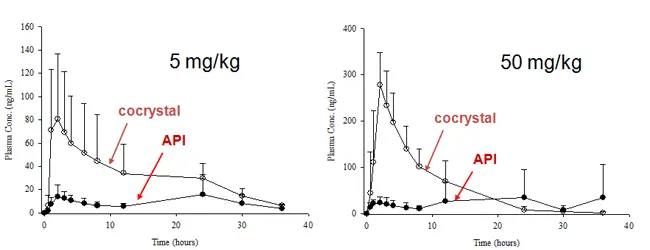
A Purdue Pharma cocrystal example illustrates how a cocrystal can show improved dissolution and in vivo exposure relative to the parent API form when formulation and physical stability are aligned.
Determine whether an API can exist in multiple crystalline forms and whether form differences change solubility, dissolution, stability, manufacturing, drug-product performance, or IP.
Screen ionizable APIs for counterions that improve crystallinity, solubility, dissolution, stability, manufacturability, or developability while controlling disproportionation risk.
Resolve form conversion, failed crystallizations, process sensitivity, stability drift, unexplained PK/dissolution changes, and batch-to-batch material differences.
Continue the solid-form program without returning to the service hub
Use the evidence from this service to select the next development decision. Triclinic can connect form selection, analytical characterization, crystallization and scale-up, and phase-appropriate cGMP support in one program.
Form selection
Compare polymorph, salt, cocrystal, and amorphous options against stability, solubility, manufacturability, and development-stage risk.
How do pharmaceutical cocrystals differ from salts?▾
Pharmaceutical cocrystals and salts are both multicomponent crystalline materials, but they differ principally in the extent of proton transfer between the API and the second component. A salt contains ionized API and counterion species, whereas a cocrystal is generally composed of molecular components associated predominantly through nonionic interactions. The distinction may be clear in strongly acidic or basic systems but can become difficult in borderline cases, requiring structural, spectroscopic, and compositional evidence.
When should a cocrystal screen be considered during development?▾
A cocrystal screen should be considered when the selected free form or salt does not adequately meet the target product profile, or when an alternative solid form could improve solubility, dissolution, stability, mechanical properties, hygroscopicity, or manufacturability. Cocrystals are particularly relevant for neutral or weakly ionizable APIs that are poor candidates for salt formation, but they may also be useful for ionizable APIs when available salts are unstable, hygroscopic, poorly soluble, or difficult to process. Screening may also be appropriate before a patent application is filed when the program needs broader experimental coverage of the solid-form landscape.
Can cocrystals improve bioavailability?▾
Yes, cocrystals can improve bioavailability when they increase dissolution, generate useful supersaturation, improve formulation performance, or alter other absorption-limiting properties. The effect is not automatic. A cocrystal may dissociate or convert to a less soluble API phase before absorption, and improved in vitro solubility does not necessarily produce greater in vivo exposure. Bioavailability improvement must be demonstrated using phase-aware dissolution, precipitation, permeability, pharmacokinetic, and formulation studies appropriate to the compound.
Why do some cocrystals dissociate during dissolution?▾
Cocrystals dissociate during dissolution because the API and coformer are held together by noncovalent interactions rather than covalent bonds. Once the crystal contacts a solvent, the components may dissolve at different rates, and the solution may favor separate dissolved species or precipitation of a more stable API phase. Dissociation is especially likely when the coformer is much more soluble than the API, when solution pH strongly ionizes one component, or when the cocrystal generates API supersaturation that is not kinetically maintained.
How are cocrystal formers selected?▾
Cocrystal formers are selected by combining crystal-engineering principles with pharmaceutical-development requirements. Scientists evaluate complementary hydrogen-bonding functionality, molecular shape, pKa, solubility, chemical compatibility, coformer safety, dose burden, route of administration, and the property the cocrystal is intended to improve. Computational and database methods can prioritize candidates, but experimental screening remains necessary because cocrystal formation and developability cannot be predicted reliably from molecular structure alone.
What analytical techniques confirm cocrystal formation?▾
X-ray powder diffraction (XRPD) establishes formation of a new crystalline phase and supports bulk phase identification. Thermal analysis, spectroscopy, and compositional testing characterize the bulk material and help distinguish a cocrystal from a salt, solvate, hydrate, eutectic, or physical mixture. When a suitable crystal structure can be solved, single-crystal X-ray diffraction or microcrystal electron diffraction (MicroED) can provide definitive structural evidence for composition, stoichiometry, and molecular arrangement; bulk methods remain important for showing that the analyzed batch is representative and phase-pure.
What regulatory considerations apply to pharmaceutical cocrystals?▾
Regulatory expectations focus on correct classification, adequate characterization, reproducible manufacture, coformer acceptability, stability, and control of attributes that affect product quality or performance. FDA's February 2018 guidance explains that a qualifying pharmaceutical cocrystal has a regulatory classification similar to, or analogous to, a polymorph of the active pharmaceutical ingredient; it is not treated as a new active pharmaceutical ingredient. A cocrystal should not be treated as a simple physical mixture merely because the API remains covalently unchanged.
What are common pitfalls in pharmaceutical cocrystal development?▾
Common pitfalls include using a formulaic screen, treating every new XRPD pattern as a cocrystal, selecting coformers without considering safety or dose burden, screening too narrowly, optimizing only solubility, failing to investigate dissociation and precipitation, overlooking polymorphs and hydrates, and advancing a material that cannot be prepared reproducibly. A successful cocrystal must provide a durable product advantage and remain controllable throughout processing, storage, dissolution, and commercial manufacture.
Talk to a Triclinic Labs scientist about Pharmaceutical Cocrystal Screening and Development
Send the material history, current data package, process conditions, development objective, and timeline. Triclinic will route the request to the right solid-form scientist. For a connected program from candidate nomination through IND, explore the candidate-to-IND solid-form development pathway.