Connect chromatographic, molecular, crystallographic, and microscopy evidence to identify unknowns.
Connect chromatographic, molecular, crystallographic, and microscopy evidence to identify unknowns.
Identify process impurities, degradants, contaminants, and crystalline particles using LC–MS, high-resolution mass spectrometry (HRMS), MicroED, NMR, spectroscopy, chromatography, and microscopy.
The content of this page has been scientifically reviewed by Steef Boerrigter, Ph.D., Research Fellow & Head Crystallographer at Triclinic Labs · Updated 8/1/2026
Impurity ID requires more than a peak label
Unknown impurities and contaminants create CMC, safety, stability, process, and root-cause questions. The key output is a defensible structure or identity assignment with enough supporting evidence to decide whether the impurity is process-related, degradation-related, contaminant-related, or form-related.
Chromatographic impurities are often available only in trace quantities, and obtaining enough isolated material for traditional spectroscopic analysis can be time-consuming and expensive. Combining HRMS formula constraints with MicroED structure evidence can resolve these impurities with far less isolated material.
Hybrid workflows reduce ambiguity
LC–MS and HRMS provide molecular-weight, formula, isotopic, and fragmentation constraints. NMR can test connectivity and functional groups when enough material is available. MicroED can solve structures from nanoscale crystalline particles, which can be decisive when the impurity is present as a small crystalline component. Raman, IR, microscopy, and chromatography help connect the assignment back to the actual sample matrix.
The final report should separate confirmed identification from plausible hypotheses, document limitations, and recommend follow-up only where it changes the CMC or quality decision.
How the evidence fits together
Question
Useful evidence
Decision output
Molecular identity or formula
LC–MS, HRMS, MS fragments, NMR, elemental or isotope information where relevant.
Candidate formula and structure assignment with alternatives and limitations.
Crystal structure or absolute configuration
SCXRD, MicroED, XRPD, spectroscopy and chemistry context.
Structure solution, unit-cell or form confirmation, stereochemical interpretation when supported.
Impurity or contaminant identity
Chromatography, HRMS, MicroED if crystalline, NMR if sufficient material, Raman and IR, microscopy.
Molecular structure of the impurity and evidence to support the search for its root cause or origin.
Solid-form or formulation ambiguity
XRPD, Raman and IR, ssNMR, DSC and TGA, microscopy, and DVS.
Phase/form assignment and control or follow-up recommendation.
Trace impurity structure assignment using HRMS and MicroED
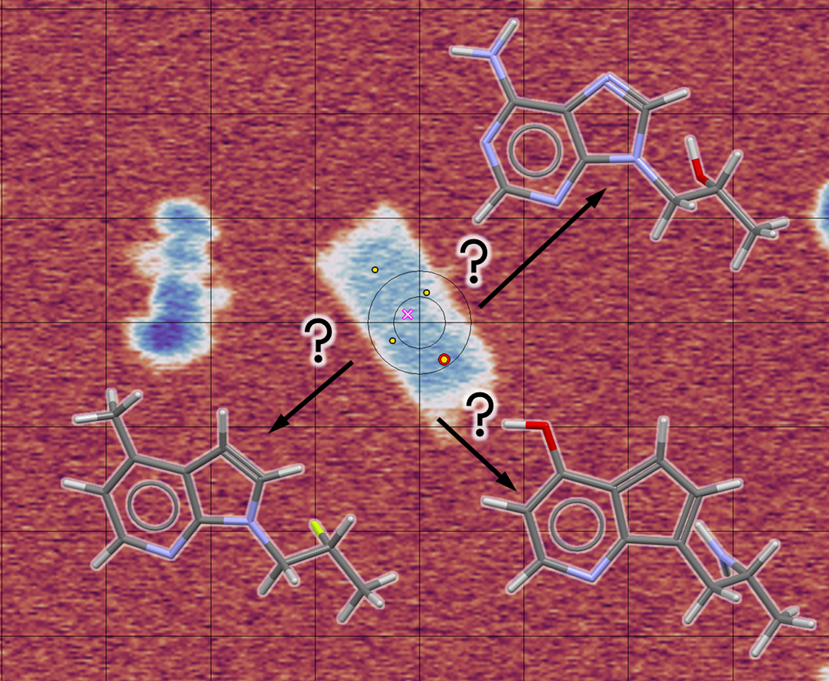
An electron-microscope image of a well-defined particle is paired with candidate molecular structures where atom assignments may be uncertain. HRMS provides accurate m/z and candidate molecular formula constraints, while MicroED can solve crystal structures from nanoscale crystallites. Together they narrow molecular possibilities when chromatography provides too little isolated material for conventional workflows. Source: George, Vanlerberghe, and Boerrigter, Molecular Structure Solution of Impurities in Liquid Chromatography Assays using Microcrystal Electron Diffraction and High-Resolution Mass Spectrometry, Triclinic Labs white paper, Q1 2026.
Examples and Publications.
These source-backed examples connect Impurity Identification to actual Triclinic materials and peer-reviewed literature. Each example includes author, publication date, and an abstract-level explanation.
Molecular Structure Solution of Impurities in Liquid Chromatography Assays using Microcrystal Electron Diffraction and High-Resolution Mass Spectrometry
Author: Gary C. George III, Jason Vanlerberghe, and Stephan X.M. Boerrigter
Publication date: Q1 2026
Abstract: Impurity peaks often exist in trace quantities that make isolation and traditional structure elucidation difficult. HRMS provides accurate m/z and candidate formula constraints, while MicroED can determine crystal structures from nanoscale crystallites, making the combined workflow useful for rapid definitive impurity identification.
Integrating Microcrystal Electron Diffraction as a Mainstream Work Tool in Solid Form Development and Structure Elucidation
Author: Shawn C. Comella, Gary C. George III, and Steef X.M. Boerrigter
Publication date: Q2 2026
Abstract: MicroED removes the large-single-crystal bottleneck by enabling molecular structure determination directly from sub-micron crystals. Integrated with expert crystallography, XRPD, HRMS, Raman and IR, and other orthogonal methods, it functions as a mainstream structure-elucidation workflow.
Microcrystal Electron Diffraction Study of Multi-component Salt and Cocrystal Forms of 3-Nitro-benzoic Acid and Pyrimethanil
Author: Stephan X.M. Boerrigter, G. Patrick Stahly, Matthias Zeller, and Christian Jandl
Publication date: Q4 2024
Abstract: One salt and two cocrystal forms in a 3-nitrobenzoic acid/pyrimethanil system were characterized by comparing SCXRD and MicroED structure results. The example is relevant to salt/cocrystal classification, proton-position questions, and the ability of MicroED to solve a new polymorph from a single impurity particle.
Which structure elucidation technique should be used first?▾
The first technique depends on the decision, material amount, sample form, and prior data. Single-crystal X-ray diffraction is preferred when suitable crystals are available; MicroED is valuable for microcrystalline particles; NMR supports connectivity and local environment; LC–MS and HRMS supports formula and fragment evidence; Raman and IR and microscopy help connect molecular and physical identity.
Can Triclinic work with very small amounts of material?▾
Yes, many structure-elucidation workflows can be scoped around limited material, but feasibility depends on crystallinity, purity, sample matrix, detection limit, and whether the question requires definitive structure, tentative identification, or triage.
Can this work support CMC, regulatory, quality, or IP decisions?▾
Yes, if the work is scoped to the evidentiary standard required. Reports should state what the data prove, what remains ambiguous, and what additional evidence would change the conclusion.
Why use orthogonal techniques?▾
No single method answers every structural question. Orthogonal evidence reduces misassignment risk by connecting formula, connectivity, phase identity, crystal structure, purity, sample history, and matrix behavior.
When is isolation required before impurity identification?▾
Isolation or enrichment may be required when the impurity is present at low concentration, coelutes with other components, produces overlapping spectra, or cannot be assigned confidently from LC–MS or other mixture data alone.
Discuss impurity-identification support
Share the impurity level, matrix, prior LC–MS or chromatographic data, sample amount, suspected source, urgency, and quality or regulatory context.