Use MicroED to obtain structural insight from crystals orders of magnitude smaller than standard SCXRD crystals.
Obtain structural insight from crystals orders of magnitude smaller than those required for single-crystal X-ray diffraction (SCXRD).
Determine small-molecule crystal structures from microcrystalline particles using microcrystal electron diffraction (MicroED) for impurities, salts, cocrystals, and pharmaceutical solid forms.
The content of this page has been scientifically reviewed by Steef Boerrigter, Ph.D., Research Fellow & Head Crystallographer at Triclinic Labs · Updated 8/1/2026
Why MicroED changes the structure-elucidation workflow
MicroED changes the bottleneck in small-molecule structure work. Conventional single-crystal X-ray diffraction still provides excellent crystallographic evidence when suitable crystals can be grown, but many pharmaceutical materials are available only as powders, micron-scale crystallites, mixed solids, trace impurity fractions, or samples that resist crystal-growth optimization.
MicroED provides a direct route from sub-micron crystallites to molecular structure, reducing dependence on growing large single crystals and moving structure determination from a crystal-growth problem into an analytical workflow.
Practical implication: MicroED should be considered early when the decision depends on crystal structure, absolute configuration, salt/cocrystal classification, impurity identity, phase assignment, or structural support for CMC and IP decisions and the available material is microcrystalline.
How MicroED should be interpreted
MicroED is a structure-determination tool, not a black-box identification test. The diffraction experiment can define the molecular geometry and unit cell from very small crystals, but interpretation still depends on data quality, beam sensitivity, dynamical scattering, phase mixtures, atom assignment, hydrogen placement, and expert crystallographic judgment.
The strongest Triclinic examples pair MicroED with orthogonal evidence. X-ray powder diffraction (XRPD) connects single-particle results to the bulk powder. High-resolution mass spectrometry (HRMS) constrains formula and atom counts for impurity assignments. Raman spectroscopy, infrared (IR) spectroscopy, nuclear magnetic resonance (NMR), differential scanning calorimetry (DSC), thermogravimetric analysis (TGA), microscopy, and chemistry knowledge help distinguish a defensible structure assignment from a plausible but under-supported model.
MicroED example selection matrix
Project question
MicroED contribution
Orthogonal evidence to include
Example source
Can a microcrystalline powder yield a definitive structure?
Collect diffraction from individual nano- to sub-micron crystallites instead of waiting for large single crystals.
XRPD for bulk phase match; SCXRD if suitable crystals later become available.
Q2 2026 MicroED workflow white paper.
Is a liquid chromatography (LC) impurity structurally identified?
Provides a 3D crystal structure from a tiny crystalline residue or high-performance liquid chromatography (HPLC) fraction deposited on a grid.
HRMS accurate mass, candidate formulae, isotope pattern, tandem mass spectrometry (MS/MS), and chemistry review.
Q1 2026 MicroED + HRMS impurity white paper.
Is a multicomponent solid a salt or a cocrystal?
Determines the crystal structure and can support proton-position assessment when data quality is sufficient.
XRPD, SCXRD when available, Raman/IR/NMR, pKa context, and hydrogen-bonding analysis.
Q4 2024 NBA-PYR salt/cocrystal study.
Are multiple phases or low-level crystalline impurities present?
Targets individual crystallites so minority particles can be indexed and solved instead of being hidden in a bulk pattern.
XRPD, microscopy, spectroscopy, and targeted fractionation where needed.
MicroED capability sheet.
Does an amorphous solid dispersion (ASD) or cloudy crystallization drop contain crystalline material?
Can analyze micro- and nanometer-sized crystallites when conventional visual inspection or bulk diffraction is inconclusive.
X-ray powder diffraction (XRPD), variable-temperature/variable-relative-humidity X-ray powder diffraction (VT/VRH-XRPD), DSC/TGA, dynamic vapor sorption (DVS), microscopy, and formulation history.
MicroED capability sheet.
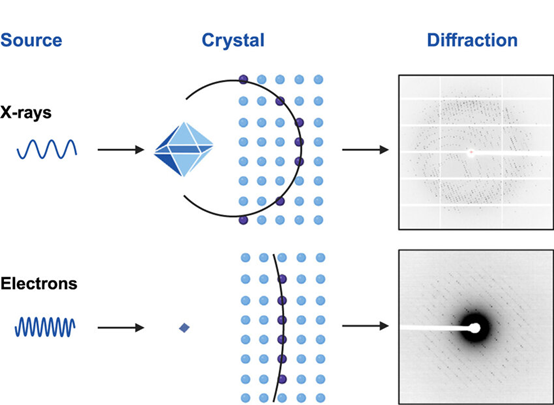
X-ray diffraction (XRD) versus MicroED: sample size and diffraction geometry
XRD relies on larger single crystals and a wider angular diffraction geometry; MicroED uses nano-sized crystallites and transmission electron diffraction. This difference makes MicroED useful when the available material is powder, a trace crystalline impurity, or a microcrystalline phase that is not practical for SCXRD. Source: Comella, George, and Boerrigter, Integrating Microcrystal Electron Diffraction as a Mainstream Work Tool in Solid Form Development and Structure Elucidation, Triclinic Labs white paper, Q2 2026.
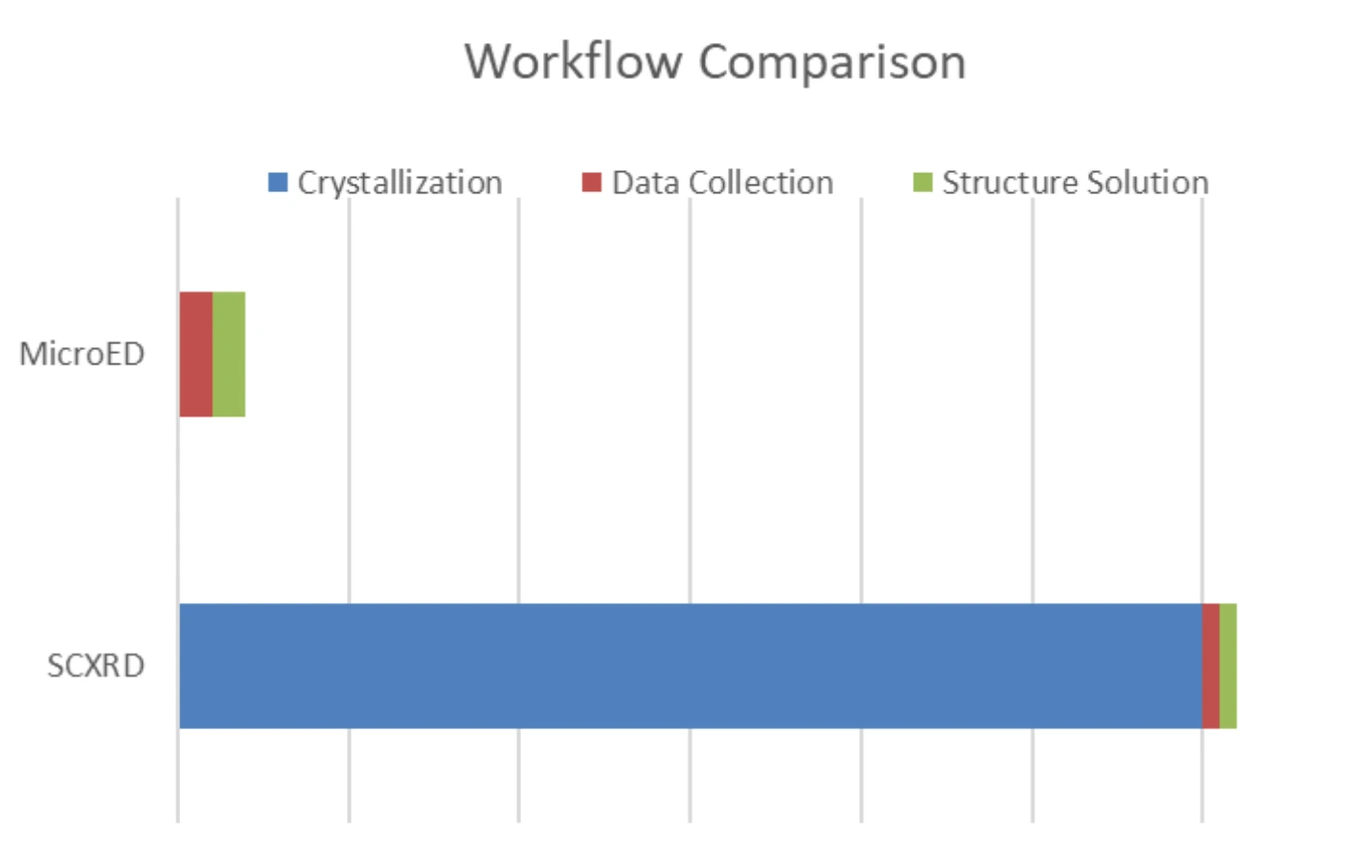
SCXRD versus MicroED workflow comparison
MicroED does not replace SCXRD; it can remove the large-single-crystal growth step when the available material already contains suitable microcrystallites. Source: Comella, George, and Boerrigter, Integrating Microcrystal Electron Diffraction as a Mainstream Work Tool in Solid Form Development and Structure Elucidation, Triclinic Labs white paper, Q2 2026.
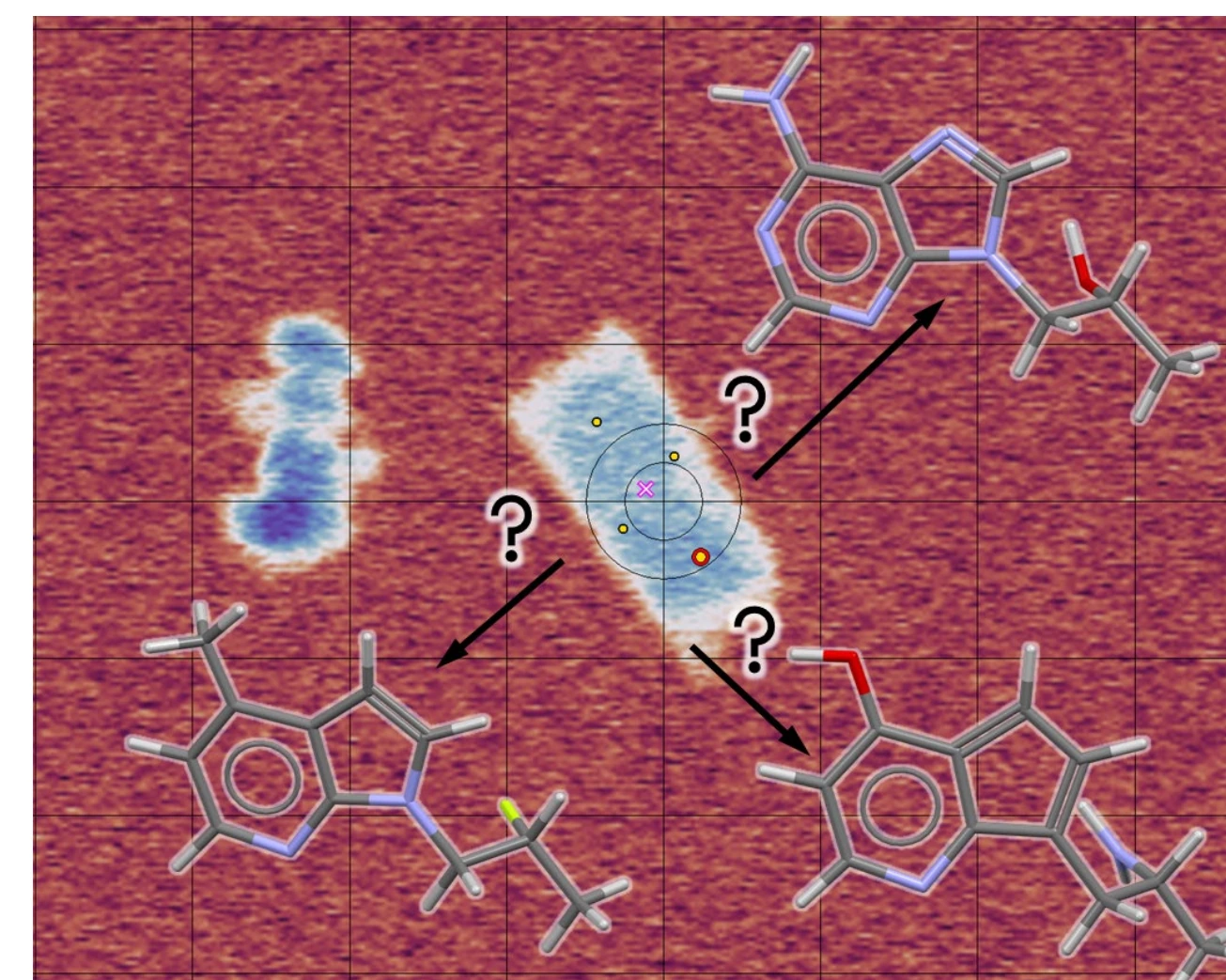
Impurity example: MicroED needs formula support when atom assignment is ambiguous
A model compound demonstrates a practical limitation of MicroED: electron diffraction can define the molecular framework, but atoms with similar scattering behavior may still be misassigned if the structure is interpreted in isolation. HRMS narrows the candidate molecular formulae and makes the final refinement chemically defensible.
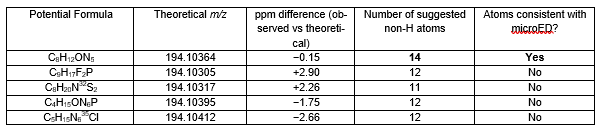
MicroED can locate and solve a crystalline impurity particle, but HRMS supplies accurate-mass and formula constraints that reduce the risk of incorrect heteroatom assignment.HRMS formula candidates within 4 ppm of the observed m/z 194.10361. The formula C8H12N5O matches the 14 non-hydrogen atoms supported by the MicroED structure and has a theoretical m/z of 194.10364 (−0.15 ppm). Source: George, Vanlerberghe, and Boerrigter, Triclinic Labs white paper, Q1 2026.
Salt/cocrystal example: MicroED can support form classification from tiny particles
The NBA-PYR study connects MicroED to a concrete CMC decision: salt versus cocrystal assignment. The study reported one salt and two cocrystal forms, confirmed structures using XRD and MicroED, and solved a new cocrystal polymorph from a single impurity particle.
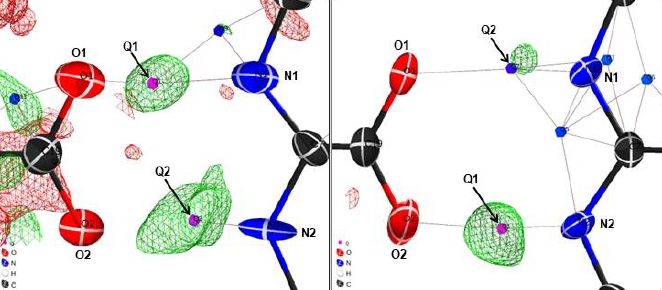
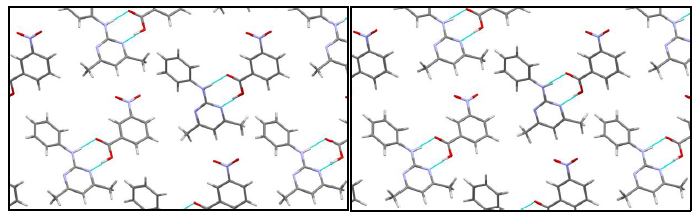
Difference Fourier maps from electron diffraction data used in hydrogen placement for NBA-PYR CC1 and S1. The example shows why MicroED should be interpreted with crystallographic expertise and orthogonal evidence, especially when proton position controls salt/cocrystal classification. Source: Boerrigter, Stahly, Zeller, and Jandl, Triclinic Labs white paper, Q4 2024.Side-by-side XRD and electron-diffraction packing comparison for NBA-PYR CC1. The study found the structures to be overall equivalent, while acknowledging that XRD was generally more precise.
Examples and Publications.
Examples and publications
These MicroED-specific examples show how the method supports structure elucidation, impurity identification, form classification, and low-sample-amount investigations.
Integrating Microcrystal Electron Diffraction as a Mainstream Work Tool in Solid Form Development and Structure Elucidation
Author: Shawn C. Comella, Gary C. George III, and Steef X.M. Boerrigter
Publication date: Q2 2026
Project relevance: Source for the XRD versus MicroED schematic, the SCXRD versus MicroED workflow comparison, and the positioning of MicroED as an early structure-elucidation tool when powders or sub-micron crystals are available.
Which structure elucidation technique should be used first?▾
The first technique depends on the decision, material amount, sample form, and prior data. Single-crystal X-ray diffraction is preferred when suitable crystals are available; MicroED is valuable for microcrystalline particles; NMR supports connectivity and local environment; LC–MS and HRMS supports formula and fragment evidence; Raman/IR and microscopy help connect molecular and physical identity.
Can Triclinic work with very small amounts of material?▾
Yes, many structure-elucidation workflows can be scoped around limited material, but feasibility depends on crystallinity, purity, sample matrix, detection limit, and whether the question requires definitive structure, tentative identification, or triage.
Can this work support CMC, regulatory, quality, or IP decisions?▾
Yes, if the work is scoped to the evidentiary standard required. Reports should state what the data prove, what remains ambiguous, and what additional evidence would change the conclusion.
Why use orthogonal techniques?▾
No single method answers every structural question. Orthogonal evidence reduces misassignment risk by connecting formula, connectivity, phase identity, crystal structure, purity, sample history, and matrix behavior.
What makes a sample suitable for MicroED?▾
A suitable sample contains crystalline particles small enough for electron diffraction, remains sufficiently stable under the electron beam, and provides interpretable diffraction from one or more crystallites. Purity, disorder, preferred orientation, and mixed phases can affect feasibility.
Discuss MicroED structure support
Share the amount available, crystallinity, prior XRPD or microscopy evidence, suspected identity, urgency, and the structural decision the data must support.