Identify and quantify elemental composition, trace metals, and particle-level elemental distributions.
Elemental results must identify the source—not just the elements present
Elemental analysis must do more than detect metals or inorganic components. A useful investigation distinguishes bulk composition from localized particles, quantifies trace elements at decision-relevant levels, and connects the result to contamination, corrosion, residual catalysts, raw materials, or product risk. Triclinic Labs integrates inductively coupled plasma mass spectrometry (ICP-MS) for trace quantitation with high-performance liquid chromatography coupled to ICP-MS (HPLC-ICP-MS) when elemental speciation is needed. Scanning electron microscopy with energy-dispersive X-ray spectroscopy (SEM/EDS or SEM/EDX) provides particle-specific composition, localization, and elemental mapping for heterogeneous samples and contamination investigations. X-ray fluorescence (XRF) and particle-induced X-ray emission (PIXE) support nondestructive elemental screening, while phase-identification techniques help determine what is present and what the evidence means for the material. Related service paths include elemental quantification and SEM-EDS, SEM-EDX, and microscopy analysis.
Choose the elemental-analysis technique based on the decision
The most useful method depends on whether the project requires total concentration, particle-level location, nondestructive screening, or trace-level sensitivity.
Analytical question
Best starting point
What the result provides
How much of an element is present in the bulk sample?
Inductively coupled plasma mass spectrometry (ICP-MS) or inductively coupled plasma optical emission spectroscopy (ICP-OES), with digestion or extraction appropriate to the matrix
Total or extractable elemental concentration for impurity control, residual-catalyst assessment, raw-material comparison, or other elemental quantification services.
Where is an element located on a particle, inclusion, or surface?
Scanning electron microscopy with energy-dispersive X-ray spectroscopy (SEM-EDS or SEM-EDX)
Localized spectra and elemental maps that distinguish a particle or inclusion from the surrounding material. See SEM-EDS microscopy analysis.
Can the sample be screened without digestion or substantial alteration?
X-ray fluorescence (XRF) or particle-induced X-ray emission (PIXE)
Nondestructive multi-element screening of intact solids, coatings, devices, minerals, or other materials, subject to method-specific sensitivity and matrix limitations.
Are trace or ultra-trace elements, or different elemental species, the concern?
ICP-MS for trace-level concentration; high-performance liquid chromatography coupled to ICP-MS (HPLC-ICP-MS) when speciation is required
Low-level multi-element quantitation and, when chromatographic separation is used, species-specific results such as arsenic speciation.
Overview of Elemental Analysis (ICP-MS, SEM/EDX, XRF, PIXE) Services
Scientific principle and analytical basis
Elemental analysis determines which elements are present and, where appropriate, how much of each is present. ICP-MS is highly sensitive for trace elements; SEM/EDX localizes elements on particles; XRF provides non-destructive bulk elemental information; PIXE can provide sensitive non-destructive multi-element analysis.
When is it used?
Use elemental analysis for United States Pharmacopeia (USP) <232>/<233> and International Council for Harmonisation (ICH) Q3D elemental impurities, foreign particulates, corrosion products, inorganic contaminants, device/coating investigations, raw materials, catalysts, minerals, and elemental mapping.
What are limitations?
ICP-MS is destructive and needs digestion or suitable prep. SEM/EDX has detection and vacuum/preparation limits, and light/volatile species can be difficult. XRF may struggle with light elements or matrix effects. Elemental data often do not identify molecular species.
What sample amounts are needed?
Amount depends on method, target elements, detection limits, and whether the sample must be retained. Particle-level SEM/EDX can use small particles; ICP-MS and XRF needs depend on preparation and regulatory limits.
Complementary Techniques
Complementary techniques include X-ray fluorescence (XRF), inductively coupled plasma mass spectrometry (ICP-MS), inductively coupled plasma optical emission spectroscopy (ICP-OES), scanning electron microscopy with energy-dispersive X-ray spectroscopy (SEM/EDX), particle-induced X-ray emission (PIXE), chromatography, mass spectrometry, X-ray powder diffraction (XRPD), spectroscopy, and microscopy. High-performance liquid chromatography coupled with ICP-MS (HPLC-ICP-MS) adds elemental speciation when total concentration alone is insufficient.
What does the U.S. Food and Drug Administration (FDA) care about?
For pharmaceuticals, FDA and ICH expectations focus on risk-based elemental-impurity control under ICH Q3D and USP <232>/<233>, including permitted daily exposure (PDE) limits, method suitability, specificity, accuracy, precision, and matrix control.
What are common mistakes?
Common mistakes include using bulk elemental data to infer molecular identity, ignoring sample contamination during prep, failing to distinguish substrate from particle, choosing a method with insufficient sensitivity, and not linking results to ICH Q3D risk.
What is Triclinic's experience with this technique
Triclinic uses elemental analysis to investigate elemental impurities, residual catalysts, inorganic contaminants, raw-material differences, and composition questions that affect safety, quality, or process understanding. Real-world applications include ICH Q3D-style risk support, contamination investigations, excipient and active pharmaceutical ingredient (API) comparability, metal-containing materials, and cases where SEM/EDX, XRF, ICP-MS, or related methods are needed to connect elements to particles, surfaces, or bulk composition.
Specific instruments and capabilities for Elemental Analysis (ICP-MS, SEM/EDX, XRF, PIXE)
The table below lists the specific platforms, brands, models, software, detectors, and capability notes relevant to this service area.
Instrument or platform
Brand, model, software, or detector
Additional capabilities and use
ICP-MS trace-element and HPLC-ICP-MS speciation platform
Microwave digestion systems available. Trace and ultra-trace elemental analysis, inorganic impurity testing, USP <232>/<233> and ICH Q3D support, multi-element method development and validation, and species-specific separation and quantitation, including arsenic speciation in complex matrices.
SEM/EDX platform
Thermo Phenom XL SEM/EDX with fully integrated elemental and backscattered electron (BSE) detector
Oxford INCA PentFETx3 energy-dispersive X-ray spectroscopy system
EDX spectra, elemental maps, and spot/region composition data.
XRF platform
Panalytical Epsilon 4 ED-XRF spectrometer
Non-destructive elemental analysis from carbon to americium, with concentration range from sub-ppm to 100 wt%.
PIXE capability
Proton-induced X-ray emission workflow
Non-destructive multi-element analysis from sodium to uranium, surface-sensitive analysis, and ppm-level elemental screening.
SEM/EDX Foreign-Particle Identification and Elemental Mapping Example
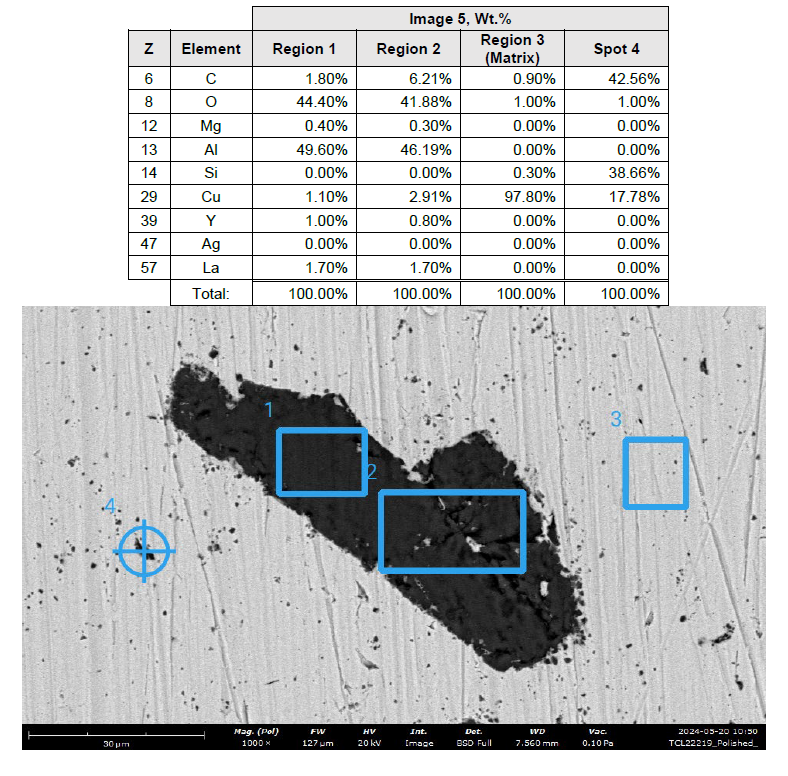
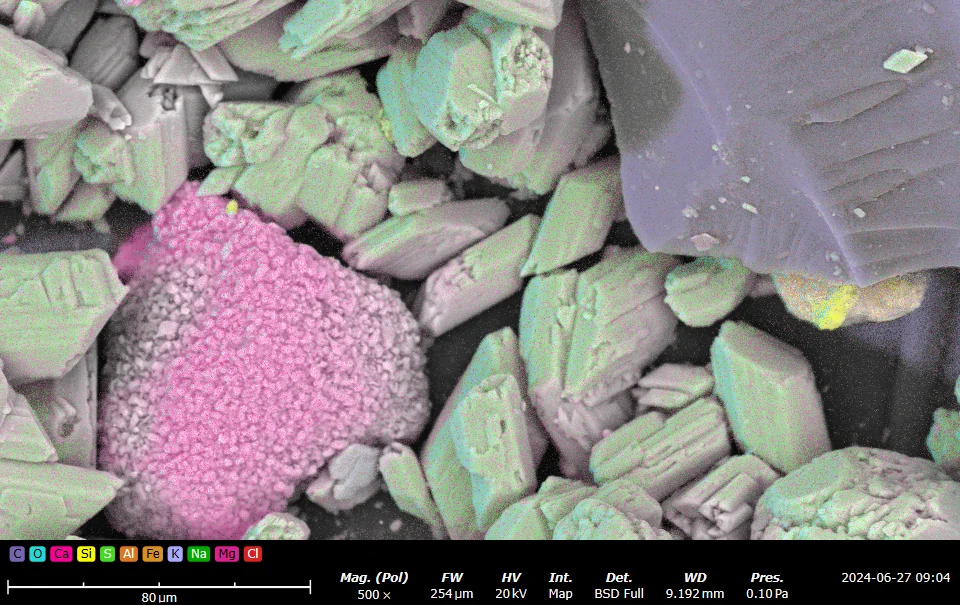
This example illustrates the difference between bulk elemental composition and particle-level evidence. SEM/EDX supports localized elemental analysis, contaminant identification, and elemental mapping. The first figure supports a foreign-particle investigation by comparing selected analysis regions and spot data. The second figure shows how false-color elemental mapping can separate particle types within a mixture.
SEM/EDX foreign-particle identification example. The figure combines an SEM image with regional and spot EDX data. Region selection matters: one region can represent the substrate, while another can represent the inclusion or particle. That makes SEM/EDX useful for contaminant triage, but also shows why sample preparation, coating, vacuum sensitivity, and matrix context must be documented. Source: Triclinic Labs elemental-analysis material.EDX false-color elemental mapping example. Element-specific colors identify different particle types in a synthetic mixture. This example is useful when a bulk elemental result is insufficient because the location, association, or particle-level distribution of the element is the actual development or investigation question. Source: Triclinic Labs elemental-analysis material.
Technical Resources and Publications
These examples include technical resources, regulatory guidances, or literature relevant to the technique. Download buttons are placed at the bottom-left of each example.
ICH Q3D(R2) Guideline for Elemental Impurities
Author: International Council for Harmonisation
Publication date: 2022
Abstract: ICH Q3D(R2) provides the risk-management framework for assessing and controlling elemental impurities in drug products. It is the regulatory anchor for elemental-impurity testing, method selection, and justification of ICP-MS, XRF, or other elemental-analysis strategies.
ICH Q2(R2) Validation of Analytical Procedures and ICH Q14 Analytical Procedure Development
Author: International Council for Harmonisation / FDA
Publication date: 2024
Abstract: FDA notes that ICH Q2(R2) and Q14 describe validation and development principles for analytical procedures used to assess drug substance and drug product quality. These guidances frame FDA expectations for specificity, accuracy, precision, range, robustness, lifecycle management, and fit-for-purpose method evidence.
A Comprehensive Approach for Solid Form Selection in Preclinical Development and Beyond
Author: Melanie Bevill, Chris Seadeek, Nico Setiawan, Shawn Comella, Blaise Mibeck, and Steef Boerrigter
Publication date: November 2023
Abstract: Solid-form screening and selection connect crystallinity, stability, solubility, hygroscopicity, manufacturability, regulatory needs, and IP objectives. Analytical techniques should therefore be selected according to the development decision rather than a fixed instrument list.
Provides rapid molecular-identification, functional-group, solid-form, mixture, and spatial-distribution evidence using Raman, FTIR, IR imaging, and UV/Vis.
Tell Triclinic what sample you have, what decision the data must support, what prior data are available, and whether cGMP, release, validation, or regulatory documentation is required.