Active pharmaceutical ingredient (API) materials and excipients possess physical and chemical characteristics that extend well beyond molecular identity. Crystal form, particle size, morphology, thermal behavior, moisture interactions, impurities, and solid-state transformations all influence manufacturing performance and finished-product quality. Triclinic Labs combines complementary analytical techniques to build a complete understanding of pharmaceutical materials, enabling clients to reduce development risk, strengthen regulatory submissions, and make better manufacturing decisions.
Overview of Bulk Powder API and Excipient Characterization Services
Scientific principle and analytical basis
Bulk powder characterization measures physical, surface, and particulate attributes such as bulk/tapped density, flow, particle size, microscopy, water uptake, contact angle, surface energy, and milling or agglomeration behavior.
When is it used?
Use it when powders behave differently despite passing chemical specifications, when milling/clogging/flow/segregation occur, or when dry-powder functionality, excipient choice, and formulation robustness need evidence.
What are limitations?
Powder tests are highly dependent on sample history, humidity, handling, consolidation, particle shape, and scale. A single powder number rarely predicts performance without process context.
What sample amounts are needed?
Sample amount depends on technique, matrix, replicate needs, detection limit, current good manufacturing practice (cGMP) requirements, and whether method development or validation is required. Confirm exact amounts at project intake.
Complementary Techniques
Complementary techniques include particle-size analysis, microscopy, scanning electron microscopy with energy-dispersive X-ray spectroscopy (SEM/EDX), dynamic vapor sorption (DVS), Karl Fischer (KF) titration, contact-angle analysis, powder-flow testing, X-ray powder diffraction (XRPD), Raman spectroscopy, and thermal analysis. Together they distinguish whether performance is being driven by particle size, morphology, solid form, moisture, surface properties, or flow.
What does the U.S. Food and Drug Administration (FDA) care about?
FDA-facing work should connect the method to a quality attribute, document sample preparation and specificity, and support validation or verification where the result is used for release, stability, or regulatory decisions.
What are common mistakes?
Common mistakes include reporting instrument results without explaining what they mean for the material or project decision.
What is Triclinic's experience with this technique
Triclinic uses bulk-powder characterization to solve practical API, excipient, and formulated-material questions involving lot comparability, powder flow, blending, milling, compaction, dissolution risk, and stability. Real-world work often combines particle size, morphology, crystallinity, water content, surface behavior, and solid-form evidence so a powder problem can be tied to a material attribute rather than treated as a generic processing issue.
Specific instruments and capabilities for Bulk Powder API and Excipient Characterization
The table below lists the specific platforms, brands, models, software, detectors, and capability notes relevant to this service area.
Laser diffraction particle-size analysis; dry range 0.1-3500 um and wet range 0.01-1400 um; supports cGMP and non-GMP method development, verification, transfer, validation, and release testing.
Hall FlowMeter AS-300
Hall FlowMeter AS-300
Powder flow rate and apparent-density testing for free-flowing metallic, ceramic, pharmaceutical, and other fine powders.
Contact-angle / wetting platform
Rame-Hart imaging system with Drop Image Advanced Software v.1.4.11 and automated dispensing system
Powder and surface wettability, contact-angle, advancing/receding wetting, and surface-energy support.
Thermo Phenom XL SEM/EDX with integrated backscattered electron detector; Oxford INCA PentFETx3 energy-dispersive X-ray spectroscopy system
Particle morphology, localized elemental analysis, elemental mapping, and contaminant or heterogeneity investigations.
Karl Fischer water determination
Mettler Toledo V20 and C20 systems, including oven KF support
Volumetric and coulometric water-content analysis for solids, liquids, formulations, and samples requiring oven-assisted water release.
Moisture interaction support
TA Instruments Q5000 DVS systems with Thermal Advantage for Q Series v.5.4.0
Moisture uptake/release, water-vapor sorption isotherms, hygroscopicity, and humidity-driven powder behavior.
API Milling Behavior and Powder Flow Failure Example
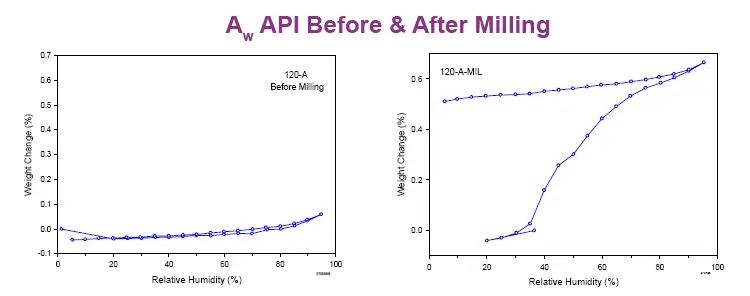
This example focuses on a common powder-development problem: an active pharmaceutical ingredient can pass required physicochemical specifications and still behave differently in the mill, during blending, or during downstream handling. An API batch before and after milling met specifications but clogged the mill. The case illustrates why bulk-powder characterization must look beyond a single specification result and connect morphology, particle size, agglomeration, flow, water uptake, and surface behavior to process performance.
API before and after milling. The example supports a development decision rather than a simple pass/fail result: if two lots satisfy the written specification but one clogs the mill, the relevant question becomes which measurable powder attributes predict the deviation early enough to prevent manufacturing failure. Particle characterization can help identify whether milling history, agglomeration, moisture interaction, surface properties, or particle morphology is driving the behavior. Source: Triclinic Labs bulk-powder characterization material.
Technical Resources and Publications
These examples include technical resources, regulatory guidances, or literature relevant to the technique. Download buttons are placed at the bottom-left of each example.
A Comprehensive Approach for Solid Form Selection in Preclinical Development and Beyond
Author: Melanie Bevill, Chris Seadeek, Nico Setiawan, Shawn Comella, Blaise Mibeck, and Steef Boerrigter
Publication date: November 2023
Abstract: Solid-form screening and selection connect crystallinity, stability, solubility, hygroscopicity, manufacturability, regulatory needs, and IP objectives. Analytical techniques should therefore be selected according to the development decision rather than a fixed instrument list.
ICH Q2(R2) Validation of Analytical Procedures and ICH Q14 Analytical Procedure Development
Author: International Council for Harmonisation / FDA
Publication date: 2024
Abstract: FDA notes that ICH Q2(R2) and Q14 describe validation and development principles for analytical procedures used to assess drug substance and drug product quality. These guidances frame FDA expectations for specificity, accuracy, precision, range, robustness, lifecycle management, and fit-for-purpose method evidence.
Abstract: ICH Q3D(R2) provides the risk-management framework for assessing and controlling elemental impurities in drug products. It is the regulatory anchor for elemental-impurity testing, method selection, and justification of inductively coupled plasma mass spectrometry (ICP-MS), X-ray fluorescence (XRF), or other elemental-analysis strategies.
Provides rapid molecular-identification, functional-group, solid-form, mixture, and spatial-distribution evidence using Raman, FTIR, IR imaging, and UV/Vis.
Frequently Asked Questions about Bulk Powder API and Excipient Characterization Services
What does bulk powder characterization measure?▾
Bulk powder characterization measures physical, surface, and particulate attributes such as bulk and tapped density, powder flow, particle size, microscopy, water uptake, contact angle, surface energy, and milling or agglomeration behavior.
When should bulk powder characterization be used?▾
Use it when powders behave differently despite passing chemical specifications, when milling, clogging, flow, segregation, or agglomeration problems occur, or when dry-powder functionality, excipient choice, and formulation robustness need evidence.
Why can a powder pass specifications but still fail in processing?▾
Chemical specifications may not capture particle shape, agglomeration, surface energy, moisture interaction, consolidation history, or flow behavior. These physical attributes can drive manufacturing performance even when identity, assay, or impurity results are acceptable.
What sample amount is needed?▾
Sample amount depends on the technique, matrix, replicate needs, detection limit, cGMP requirements, and whether method development or validation is required. Exact amounts should be confirmed at project intake.
Which techniques are commonly combined with bulk powder characterization?▾
Particle-size analysis, microscopy, SEM/EDX, DVS for humidity-response behavior, Karl Fischer titration for water content, contact-angle analysis, powder-flow testing, XRPD, Raman spectroscopy, Fourier-transform infrared (FTIR) spectroscopy, and thermal analysis can be combined depending on whether the problem appears to involve particle size, morphology, solid form, moisture, surface properties, chemistry, or flow.
What does FDA care about for powder-characterization data?▾
FDA-facing work should connect the measurement to a quality attribute, document sample handling and specificity, and support validation or verification where the result is used for release, stability, comparability, or other regulatory decisions.
What are common mistakes in bulk powder investigations?▾
Common mistakes include reporting instrument results without explaining what they mean for the material or project decision, using non-representative material, ignoring humidity and handling history, failing to document sample preparation, or not using orthogonal methods when one test is not specific enough.
Can bulk-powder testing explain manufacturing variability?▾
Often, yes. Differences in particle size, shape, surface area, density, moisture response, cohesion, flow, electrostatics, or agglomeration can help explain blending, feeding, compression, coating, filtration, or transfer problems.
Discuss bulk powder analysis with us!
We'd be happy to discuss bulk powder characterization approaches to measure physical, surface, particulate attributes such as bulk/tapped density, flow, particle size, microscopy, water uptake, contact angle, surface energy, and milling or agglomeration behavior. Click the button to get started...